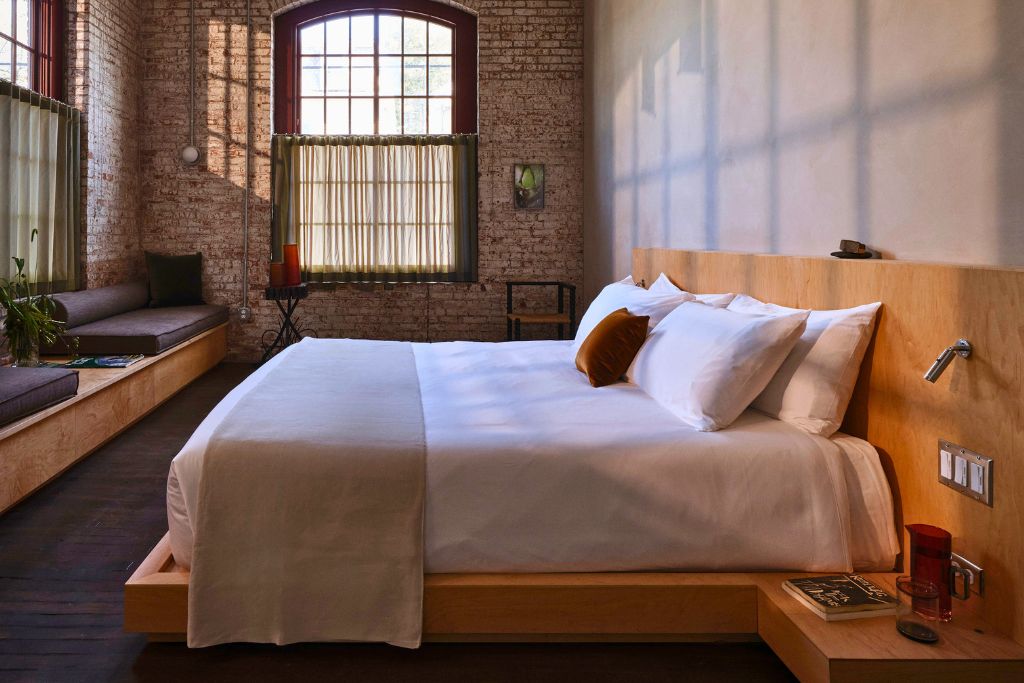
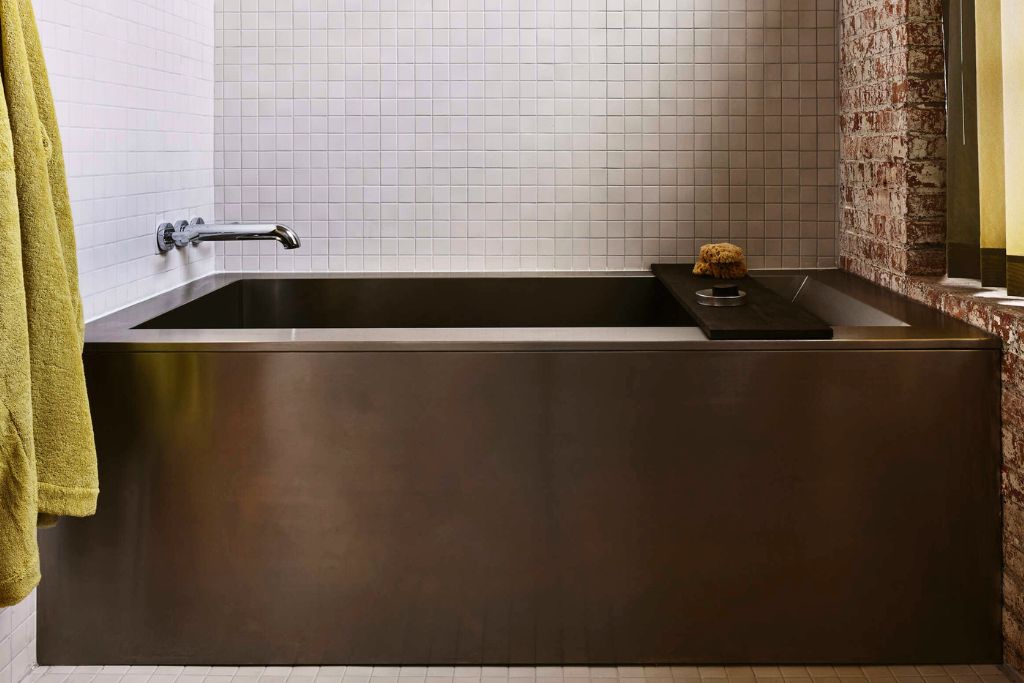
Somehow, I didn’t notice it at first. Maybe it was the pair of enormous 10-foot windows, their restrained arches showcasing the 19th-century mason’s detailed work that caught my eye. Or perhaps I was distracted by the gentle squeak of the wide plank floors and looked down to notice the grain, softened by centuries of wear. More likely, though, was that the massive but perfectly scaled brushed stainless bathtub tucked into the space between my low-slung bed and the wall melded like rising steam into the rough-hewn industrial space.
The tub wasn’t my first visual surprise at Pocketbook Hudson which opened in late 2025 in a former pocketbook factory in Hudson, New York. That had occurred in the lobby bathroom, where artist Misha Kahn had fashioned each sink into a Rube Goldberg-style ceramic waterfall: push a button on the wall, and the water cascades through a sequence of fantastical wall-mounted vessels before splashing into the basin.
Informed that my room wasn’t quite ready, I decided to explore the Pocketbook’s public spaces. My first stop was KASURI, a fashion boutique selling men’s and women’s clothing and accessories by cutting-edge designers like Annette Gortz, Noir Kei Ninomiya, and Eckhaus Latta, who also created the hotel’s signature green bathrobes. Set into an open 6,000-foot area on the former factory’s second floor, the atelier was flooded with so much light that I felt as if I was shopping outside.
When Pocketbook’s developers first became aware of the building they would transform into a hotel, the former factory was owned by Eleanor Ambos, who used it to store the antiques and other pieces she used in her interior design business. Walking into the vast windowed expanse of SHOW:ROOM, which is filled with artfully arranged furniture, lighting, ceramics, paintings, textiles, and other antique and handcrafted home goods, I could imagine Ambos lovingly perusing her collection, which had taken decades to assemble.
As I was leaving SHOW:ROOM, I ran into the same front desk employee. Not only had she tracked me down to let me know that the room was now ready, but she had brought both a key and my suitcase, saving me a trip back downstairs. I was bowled over by the unexpected hospitality.
Eating and Drinking
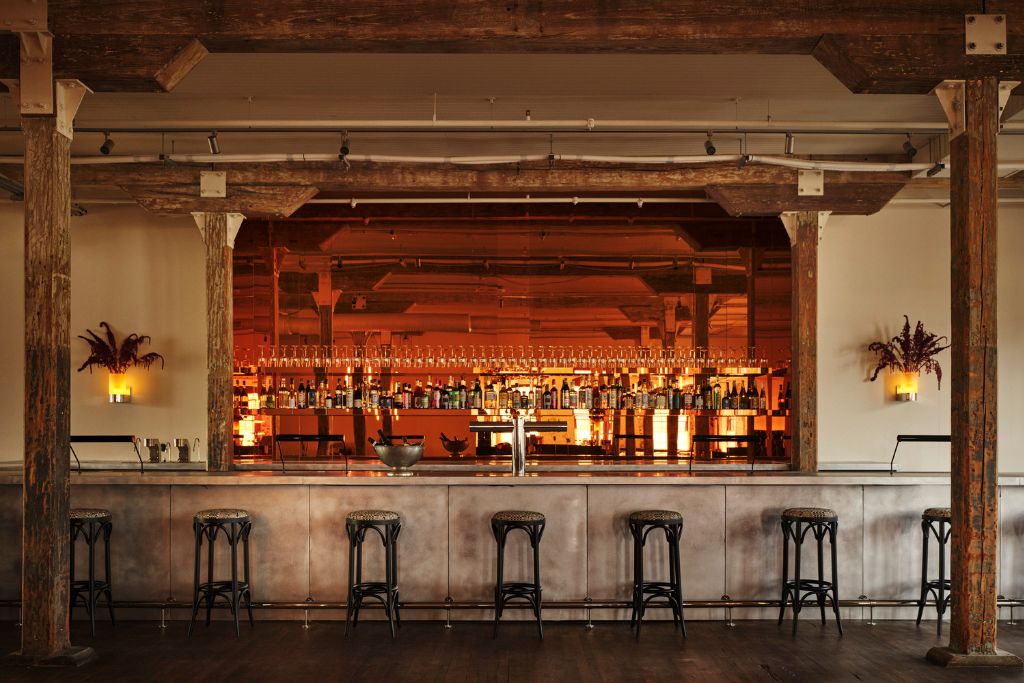
Earlier in the day, when I had first entered Pocketbook, I zigged when I should have zagged and ended up in the lounge rather than the lobby. Like most of the public areas within the hotel, the room doesn’t shy away from its size: the high shiplap ceiling is painted white, the almost floor-to-ceiling windows are uncovered and the backs of Bordeaux-hued banquets are low enough to allow a clear line of sight of the entire room. Still, thanks to warm lighting and the golden glow of the long 15-seat bar, it’s a comfortable, welcoming space. You can sit at one of those bar stools any time from 8 am and order breakfast, lunch or, if there are any left from the morning, homemade cookies or pastries.
Located in a quiet corner of the bar area lies Ambos, the hotel’s evening restaurant (it serves weekend brunch as well). Chef Norbetto Piattoni’s early studies as a scientist may have informed his knowledge of live-fire cooking and fermentation (both of which figure prominently in the menu), but it was the balance he gave every dish that made the meal so memorable. Sweet scallop crudo was enlivened with sour corn and a bracing wash of cilantro oil, while hazelnuts, apples, and a grate of Gouda softened a bitter chicory salad. Mains — a fish, a meat, a bird, and a vegetarian option — are equally taut. Offbeat additions, like fermented cranberries, celeriac, salsify, and black walnuts were inspiring and delicious, as was a dessert of sheep yogurt gelato swimming in a sweet bath of honeyed citrus.
The Bathhouse
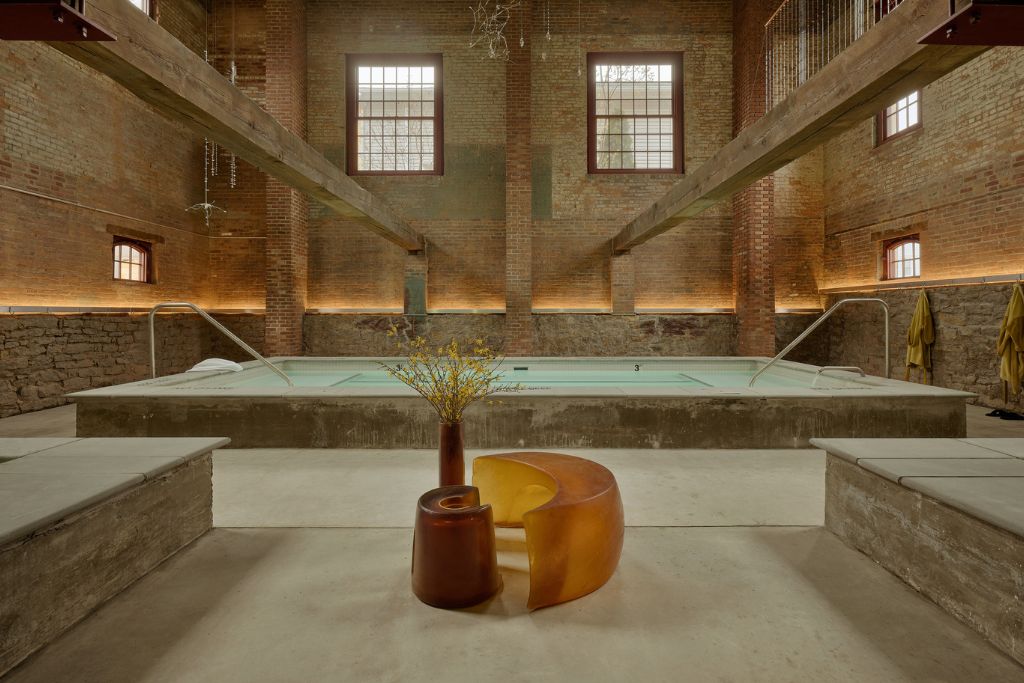
Enroute to the bathhouse, I was apprehensive about crossing the grassy courtyard that separates it from the main hotel building, but I shouldn’t have been: exiting the back door, I joined a short parade of terry-clad guests making their way awkwardly across the neat green lawn in hotel slippers. Entering the bathhouse’s small lobby, I exchanged my terry slippers for a waterproof version, grabbed a towel, and followed the attendant into the bathing area. After a quick shower, I entered the bathhouse itself, where I found three raised pools the color of the Blue Lagoon set in a room of exposed limestone foundation, whitewashed brick, weathered timbers, and high windows. For the next 10 minutes or so I soaked in the largest of the three pools, which is filled with saltwater warmed to 100 degrees, and induced that kind of bliss that only floating can bring. Then I got serious, moving from the sauna to the cold plunge for three exhilarating rounds of contrast therapy.
Massages and facials, each 90 minutes, are customized well beyond pressure preference to rebalance and reintegrate both mind and body. Fitness classes are also free form, each utilizing a variety of modalities to generate the desired result be it sweat, self-discovery, or equilibrium. I wondered if feeling good about eating a second helping of sheep yogurt gelato counted as a valid goal.
Nearby
Officially, Hudson is a city, but, for visitors, it reads like a village. Most of the action revolves around Warren Street, which works its way for about a mile between the Hudson River and Prospect Avenue. During the Revolutionary War, Hudson’s protected port pulled much of the whaling industry from Nantucket’s exposed shoreline. When the war ended, other industries moved in, including fabric mills and, later, concrete plants. At one point during the early 20th century, a surprisingly well-known red light district prospered. But the buildings constructed by wealthy residents during each of Hudson’s prosperous eras survived. In the 1980s, antique and vintage dealers renovated the graceful mishmash of Federal, Greek Revival, Second Empire and Queen Anne structures, filled them with their wares, and transformed Hudson into an antique hunter’s dream locale.
Shopping: Today, Hudson is still a top destination for high-end period furnishings, lighting, and objet d’art: STAIR Galleries was the auction house for collections owned by Joan Didion, André Leon Talley, and Charlotte Moss; Red Chair’s shelves overflow with French porcelain, sterling silver flatware and pieces from Sweden. But I was also thrilled to find clothing boutiques like Made X Hudson and Loup, their stock pieces designed and created in the Hudson Valley. There are also traditional clothing stores as well as coffee shops, restaurants, bars, hotels, and design shops alongside vinyl stores, used book shops, and more vintage.
Dining: Restaurants are locally owned, support area farmers, respect each season, and turn out remarkable things to eat from Malaysian small plates in a vintage furniture store (Backbar) to La Perche, where you can grab anything from a meatball sandwich to a classic almond croissant. Make time to spend an evening at The Maker, starting with cocktails in the art-filled lobby bar — you’ll want to sip a Vesper martini on one of the vintage settees — before moving to the dining room of Serre, which occupies an elegant glass-walled conservatory filled with lush tropical plants, flickering candles, and velvet chairs. Chef Jonas Offenbach mixes classic French technique with fresh flavors and enough depth for serious wine.
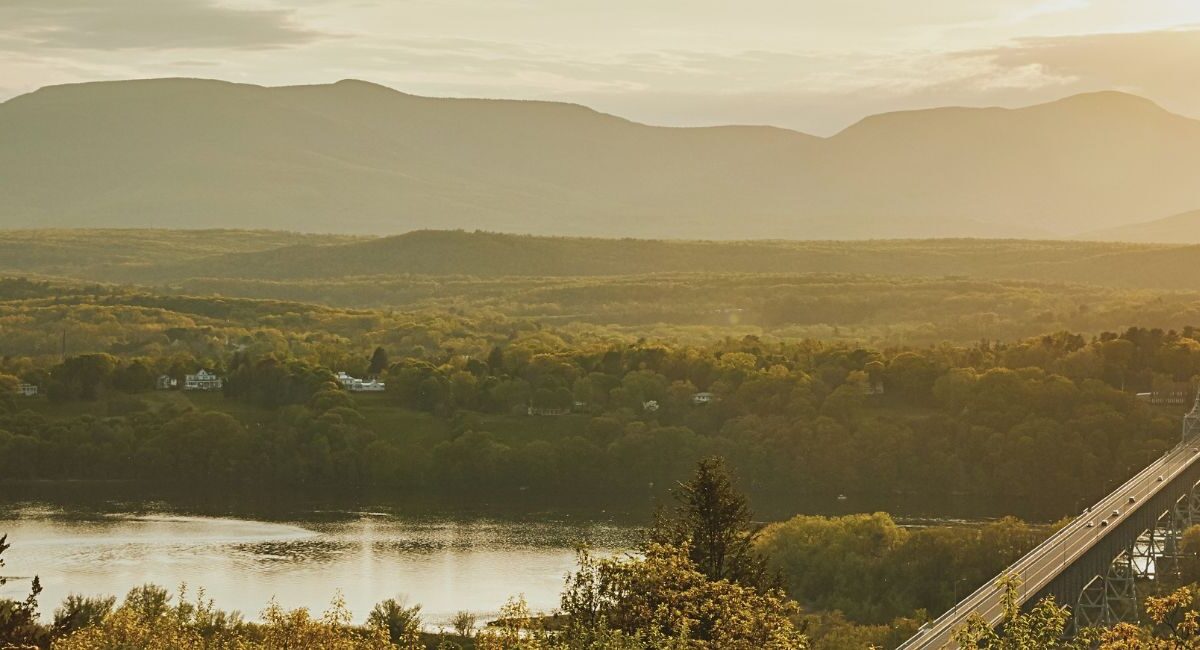
Landscape and Art: You’ll want to explore. The region is filled with pathways, hiking trails, and gorgeous viewpoints; one of the best places to take it in is at Olana, the palatial, Persian-inspired home of Frederic Church, who, in the 19th century, was considered the most successful painter in the United States. You can take a guided tour of the mansion, which is filled with his work and collections from his world travels; there are also more than five miles of hiking trails that wind through the 250-acre mountaintop property and look out over the river. Church’s mentor, Thomas Cole, lived just across the river in the town of Catskill. He was the founder of America’s first major art movement, the Hudson River School. His influence is still felt today. Cole’s home and studio are open to the public.
Getting to Hudson, NY
Whether you drive or take the train, it takes about two hours to get from midtown Manhattan to Hudson.
Featured image courtesy of Zio & Sons.