Honor the past with a stay at one of these historic U.S. hotels with intriguing backstories and claims to fame.
Many hotels tout a storied past, but in certain cases, it’s nothing more than a faux patina meant to evoke an aura of historical significance. Other properties need not bother with hyperbole or creative tall tales, because their true life histories speak for themselves.
These inimitable properties have fascinating anecdotes to share not because they’re seeking to embellish their own standing, but rather, because consequential citizens spent their time there, and in some cases, momentous events unfolded within their grounds. As all eyes continue to be fixed on America 250 and the year-long celebrations of this special anniversary, it’s worth turning our gaze to these living landmarks.
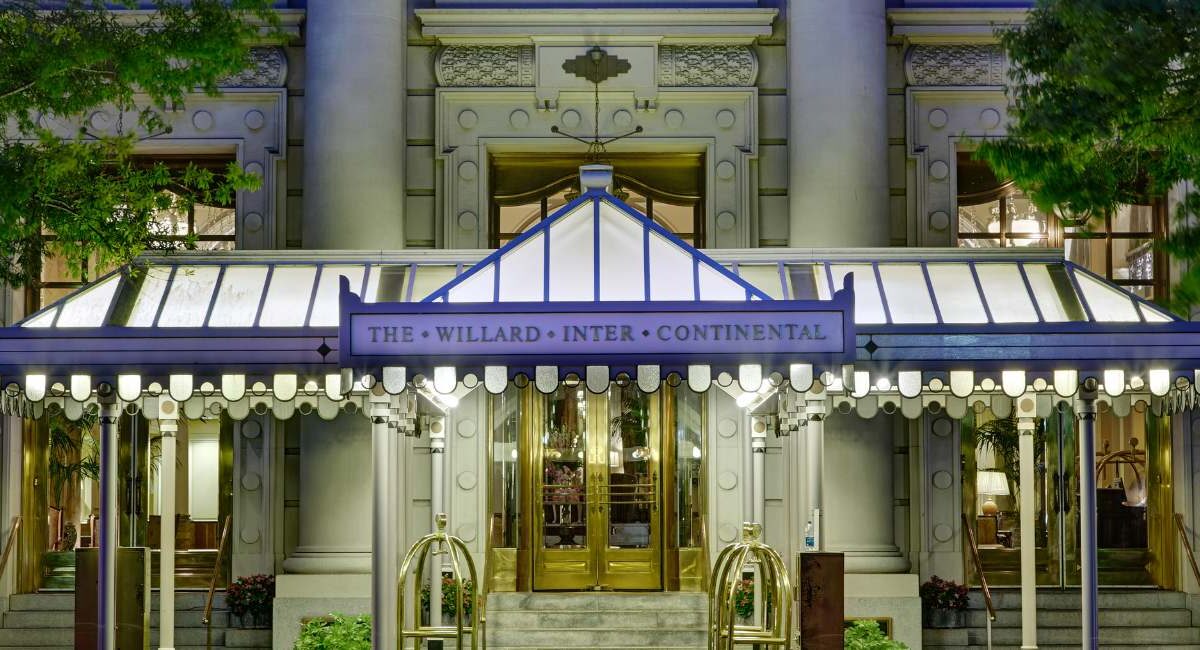
Take the two-century old Willard InterContinental in Washington, D.C. From Martin Luther King Jr. to President Ulysses S. Grant, the tales may be tall, but they also happen to be tremendous and true.
Consider a lesser known story of how the mint julep became the de facto drink of choice at the hotel’s Round Robin Bar back in 1830. Legendary barman Jim Hewes, who spent more than three decades at Round Robin, once told me, “My mint julep is the same recipe that Henry Clay would have used to make a mint julep for somebody back in the early 1800s.”
Clay, a U.S. senator from Kentucky, was an imbibing advocate of the icy, refreshing libation, and is said to have introduced the drink to Round Robin patrons in 1830. Even if the drink had been previously concocted, Clay, of course, chose his state’s native bourbon to deploy in the beverage and share with the world. The bar became the cocktail’s spiritual home, until it would eventually become synonymous with the Kentucky Derby.
These are the untold nuggets of decades and centuries past that bring iconic properties back into the spotlight today. Take a historical hotel tour across the U.S. with stops at legacy hotels with tantalizing stories to share.
Willard InterContinental: Washington D.C.
The Willard InterContinental traces its roots back to a guesthouse in 1818. The Willard family dubbed it Willard’s City Hotel in 1847, and by 1901, its famed Beaux-Arts building was completed. Politicos turned the property into a hobnobbing hot spot from its earliest days, thanks to the likes of Clay and other bon vivants of the era.
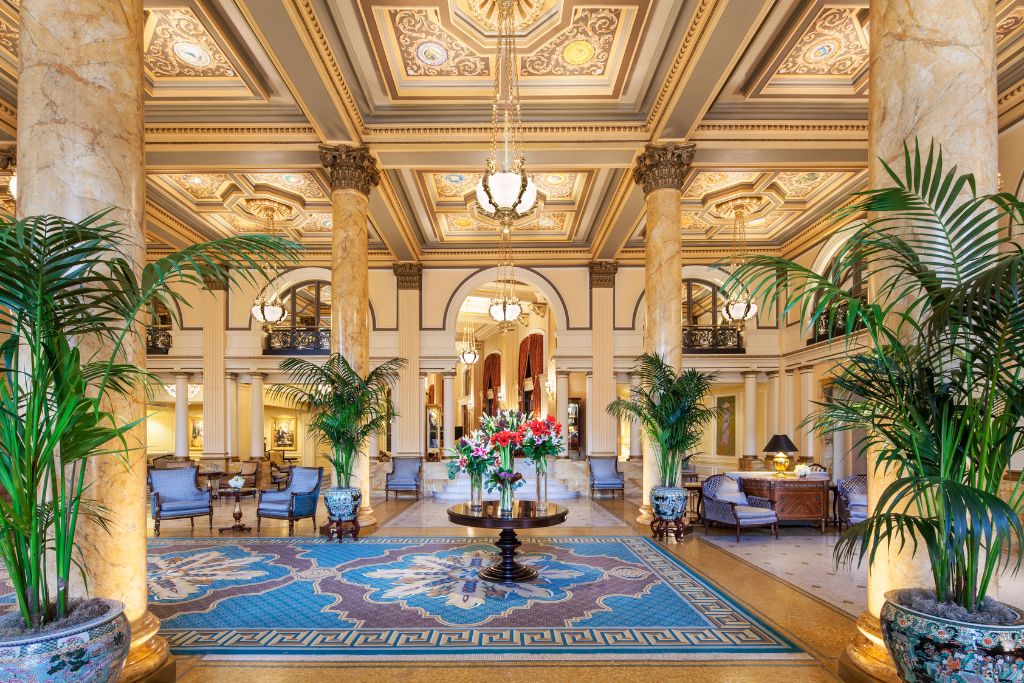
But it was in 1869 that an only-in-D.C. moment occurred. New sitting President Grant popularized the term “lobbyist” in reference to the masses clawing for attention — and perhaps a quiet word and a trade of favors — who waited in the lobby and pounced at a moment’s notice, ruining his quiet enjoyment of a cigar and brandy.
The anecdotes only continue from there. Martin Luther Kingwrote his draft of what would become the “I Have a Dream” speech in the Willard’s lobby on the evening of August 27, 1963. He gave the iconic speech the next day in front of 250,000 enraptured spectators. Suffice it to say that presidents and world leaders shaped history within the Willard’s doors, and for guests who stay there now, there’s a sense that another history-making moment could always be just around the corner.
The Greenbrier: White Sulphur Springs, West Virginia
The Greenbrier is as old as the Declaration of Independence. Almost. The hotel has been open since 1778, so we can soon decamp to West Virginia to begin celebrating Greenbrier’s 250th. The enormous hotel in its current form debuted in 1913 and currently has a sprawling 11,000-acre estate.
At least 28 U.S. presidents have visited the property, including 13 who were in office. And the hotel has been a go-to governmental resource in its two-and-a-half centuries. It was closed during the Civil War, serving as a hospital and military command center, and was closed again in World War II, first becoming a diplomatic home base and then being used by the U.S. Army as the 2,000-bed Ashford General Hospital.
Perhaps the most fascinating tidbit is that during the ensuing Cold War, the government turned to the property yet again. This time for what was known as Project Greek Island, an underground bunker and emergency relocation center designed to house the entirety of the U.S. Congress in the event of a potential nuclear war.
Omni Parker House: Boston, Massachusetts
The Omni Parker House in Boston was founded in 1855 and reigns as the longest continuously operating in the country. There’s a lengthy list of legends tied to the Parker House, fittingly enough for a property that predates the Civil War and is located amid Boston’s Freedom Trail.
A young John F. Kennedy is said to have proposed to Jacqueline Bouvier at Parker’s Restaurant in June 1953. Table 40, to be exact. While Martin’s Tavern in Georgetown also claims this particular piece of heritage, left undisputed is that JFK then held his bachelor party in the hotel’s Press Room. But his ties to the hotel go even deeper: at the age of six, he appeared at an event for his grandfather, John Fitzgerald ,at the same Press Room and, 23 years later, he announced he was running for Congress from, yes, the very same room.
The hotel certainly boasts its own lore, and it has its own literary chops as well. Charles Dickens gave the first public reading of A Christmas Carol at the hotel in 1867, as part of what was known as its Saturday Club. He even lived in the hotel for five months between 1867 and 1868.
Oh, and if the name “Parker House” is making you salivate for an unknown reason, you’re probably thinking about the Parker House Roll. It was invented at the hotel in the 1870s. A few decades prior, a sweeter treat made its starring debut at the property: the Boston Cream Pie originated at the Parker House in the 1850s.
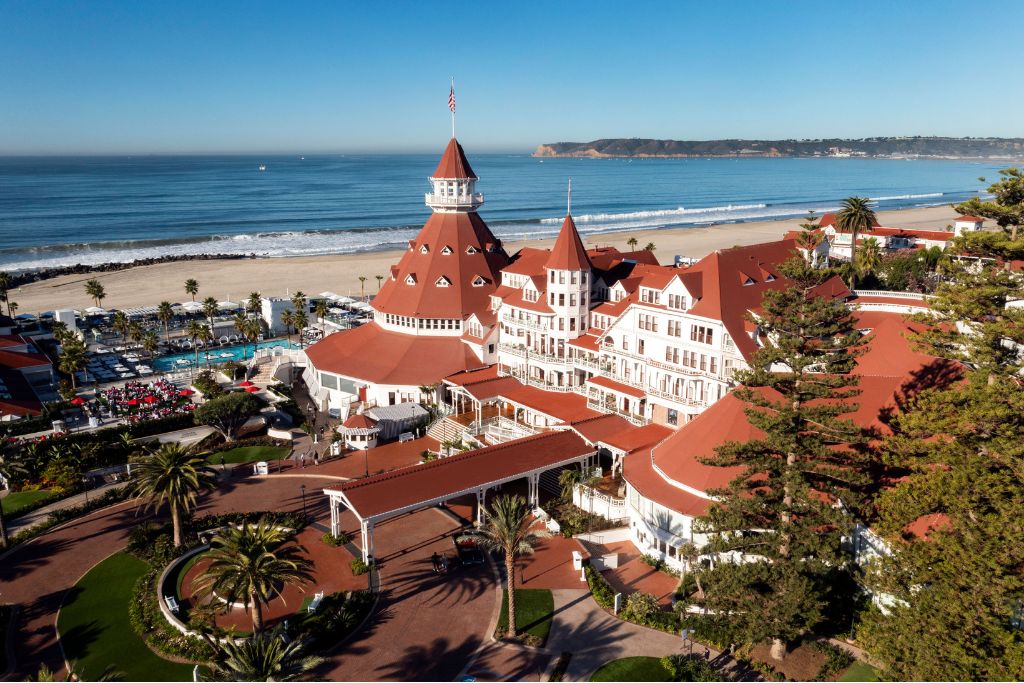
Hotel del Coronado: San Diego, California
When the Hotel del Coronado opened in 1888, it became the largest resort hotel in the world. And to this day, it’s the second largest wooden structure in the entire country.
The Del wasn’t just large, though, it was modern and novel in startling ways. Its red-roofed ballroom tower soared to a peak of 120 feet, an artificial ice machine was capable of producing 15 tons of ice per day (consider that ice only began appearing in cocktails about half a century earlier), and its elevator could ferry a 2,500-pound load. Not only was it one of the largest electrified buildings of its era, but it also supplied electricity to the surrounding town itself.
President Benjamin Harrison visited in 1891, soon after the property’s debut, while in the modern era, presidents spanning the political and personality spectrum from Richard Nixon to Barack Obama have visited in turn. The hotel reopened in June 2025, fresh off a six-year, half-billion-dollar renovation project, bringing its former grandeur back to life while preserving its unique facade.
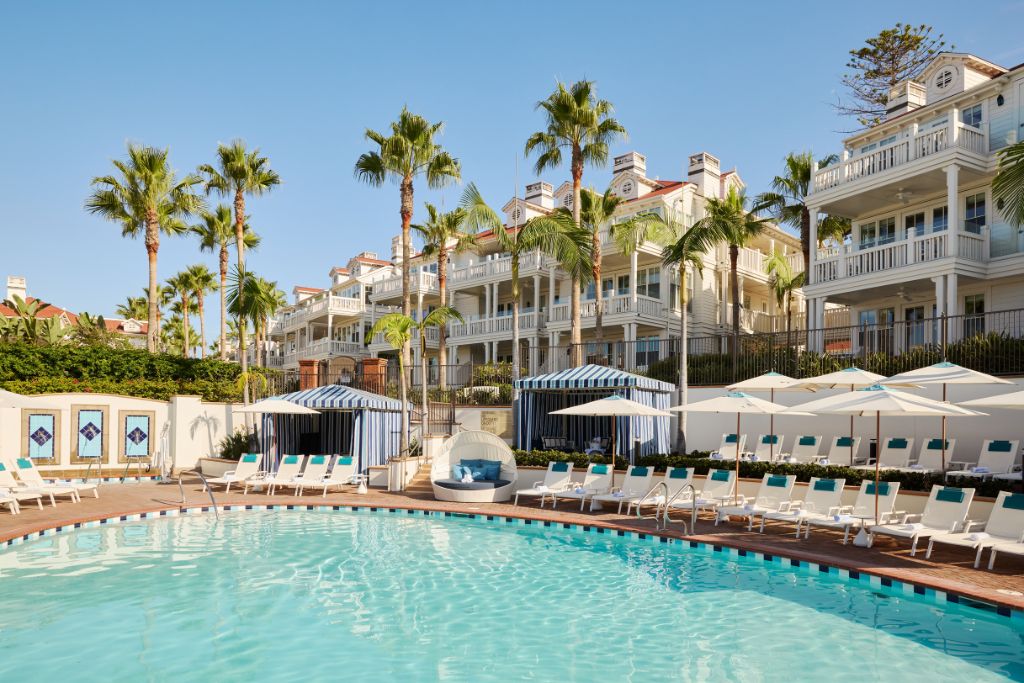
The Blackstone, Autograph Collection: Chicago, Illinois
The Blackstone debuted in Chicago in 1910 and quickly became a political powerhouse. Enough so that it soon was known as the Hotel of Presidents, with Kennedy, Eisenhower, and Truman all being noted visitors in the decades that followed.
But its importance was felt more promptly than that. Just as the word lobbyist came into existence at The Willard the phrase “smoke-filled room” — referring to shadowy backroom dealings where matters of import are decided upon removed from pesky, prying public eyes — was birthed at The Blackstone. It was the result of the 1920 Republic National Convention, in which Warren G. Harding was nominated as the party’s presidential candidate after such closed-door meetings at the hotel, emerging from nowhere to earn the nod.
The hotel was equally notorious — or less so, depending on your perspective — as being favored by another corrupt sect: the mob. Al Capone is said to have held meetings while getting his hair cut at its barbershop, and Lucky Luciano was another patron of the era. In fact, he hosted his own national convention there, this one intending to establish a board for the National Crime Syndicate in 1931.
Mayflower Hotel, Autograph Collection: Washington, D.C.
The Mayflower Hotel is fresh off a centennial anniversary, having celebrated its 100th in 2025. While there are older hotels in D.C., it stakes its own claim as technically being the longest continuously operated hotel in the city. And with more than 500 guest rooms, it’s also touted as the largest luxury property in town.
The property hit the ground running after its 1925 debut. Just two years later, it hosted a 1,000-person breakfast in honor of Charles Lindbergh being awarded the Hubbard Medal by the National Geographic Society. Then, in 1933, President Franklin D. Roosevelt wrote his inaugural address at the property. On March 3rd, from his comfortable confines in room 776, he wrote what would become one of the most famous and repeated quotes in American history: “The only thing we have to fear is fear itself.”
President Truman would later dub the hotel “Washington’s Second Best Address,” while FBI director J. Edgar Hoover dined at the Carvery Restaurant and Coffee Shop almost every working day over a two-decade span.
Omni Homestead Resort: Hot Springs, Virginia
The Omni Homestead Resort first opened in Hot Springs Virginia in 1766 as The Homestead, then little more than a log cabin. It’s regarded as the oldest resort in the United States.
A total of 24 U.S. presidents have visited, but perhaps the most interesting instance was when a rheumatoid arthritis-stricken Thomas Jefferson visited the resort in 1818. He spent 22 days convalescing with the help of its natural, 98-degree mineral-rich waters.
The modern 2,300-acre resort began taking form in the late 1800s, a project spearheaded by J.P. Morgan. Its current main lobby was reconstructed in 1902. In World War II, Japanese diplomats and their families were kept at the property awaiting exchange to be sent home, before being moved to the aforementioned Greenbrier.
And while this story can’t be entirely devoted to old-school Omnis, the Omni Bedford Springs Resort is another worth noting. Jefferson was a visitor there as well, among a dozen presidents in total. Most notably, James Buchanan made the resort a seasonal getaway, referring to it as his Summer White House.
Grand Hotel: Mackinac Island, Michigan
Mackinac’s Grand Hotel has always been exactly that: grand in stature and grand in scope. The property debuted in 1887, and remains home to the largest front porch in the world, a staggering 660-foot construction. It’s where Thomas Edison demonstrated his phonograph, a fitting perch for such a porch spectacle. Other early notable events include Mark Twain holding a lecture at the property’s casino in 1895.
The Grand Hotel and its location on Mackinac Island have helped one another retain their historical splendor. No motorized vehicles are allowed on the island to this day; it is only reachable via ferry or plane. The hotel touted welcoming its 5 millionth visitor in 2006. And six of them have been presidents, with a more modern slant than many of the other hotels included here, including Biden, Clinton, Bush, Ford, Kennedy, and Truman.
The Hay-Adams: Washington D.C.
When it comes to The Hay-Adams, look no further than its namesakes. The property is named for John Hay — personal secretary to Abraham Lincoln, U.S. ambassador to the United Kingdom, and two-time Secretary of State — and Henry Adams, descendant of Presidents John Adams and John Quincy Adams (who perhaps wisely became a historian and professor in the wake of his forebears).
These two owned the adjacent Romanesque homes, designed in 1884 by Henry Hobson Richardson, which eventually became the hotel. But while they were still residences, each entertained a who’s-who crowd, including the likes of Teddy Roosevelt and Mark Twain. A new combined Italian Renaissance structure was built across the two sites in 1928 by Mihran Mesrobian, and with its dead center position in front of Lafayette Square, looking straight to The White House, has been a favored locale ever since. A grand tradition of entertaining A-listers soon continued, with the likes of Amelia Earhart and Charles Lindbergh among early guests.
Today much of the magic goes unrecorded, thanks to the well-named Off The Record. The sultry basement bar, lined with its political caricatures, attracts a who’s-who crowd from every public-facing sphere in the realm. But the hush-hush hospitality prevails.
The Broadmoor Hotel: Colorado Springs, Colorado
The Broadmoor Hotel opened in 1918 in Colorado Springs and remains a mountain lover’s dream escape. At an elevation of 6,230 feet, it’s a jumping off point for the adjacent Cheyenne Mountain and lake, and the numerous outdoor activities you can enjoy amid the Rockies. Early diversions included an indoor swimming pool touted as the largest in the Western United States when the property debuted, and a pair of resident flamingos.
One tale of note is that founder Spencer Penrose was none too happy about the country’s veer into the world of prohibitionism. It’s said that he stashed more than 300 cases of liquor at his hotel. However, its juiciest historical anecdote takes place in 1963. That year, childhood friends Truman Capote and Harper Lee decamped to The Broadmoor for an extended stay while researching and writing Capote’s mesmerizing In Cold Blood. The two all-time authors grew up as neighbors in Alabama, a fearsome pairing for English teachers at the local school system, no doubt.
Featured image courtesy of Willard InterContinental Washington, D.C. Travel Curator may earn a commission from booking links on this page.