Captain Leonardo Hidalgo stands on the stern of Evolve in his crisp white uniform, waiting for our pangas to pull alongside.
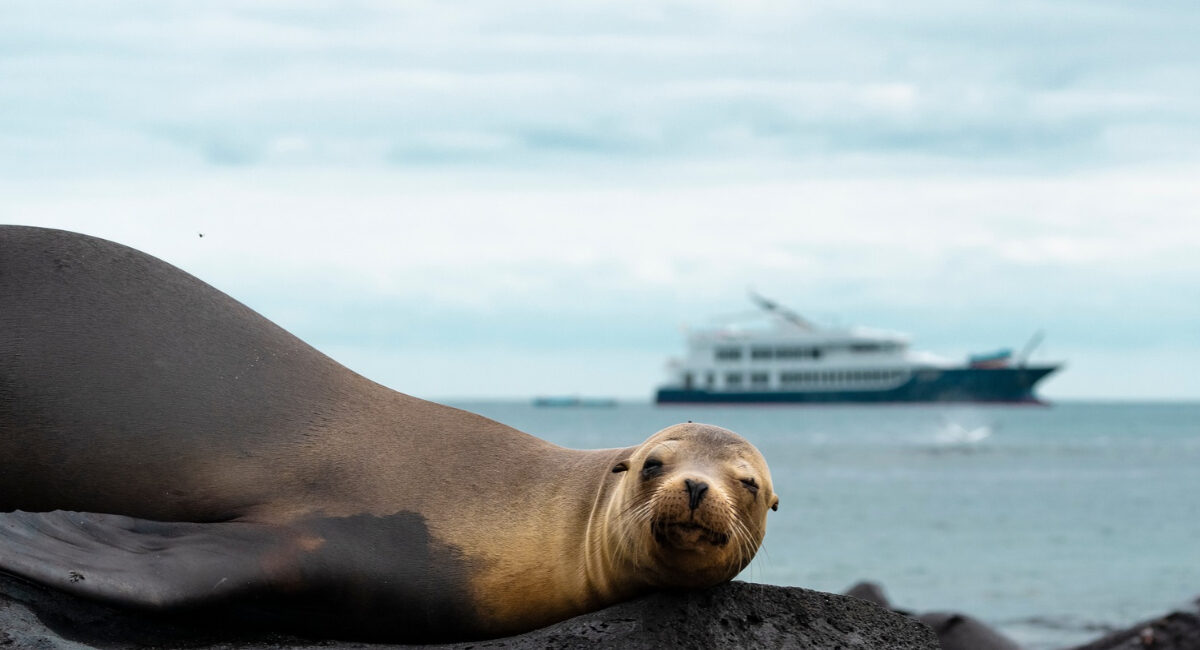
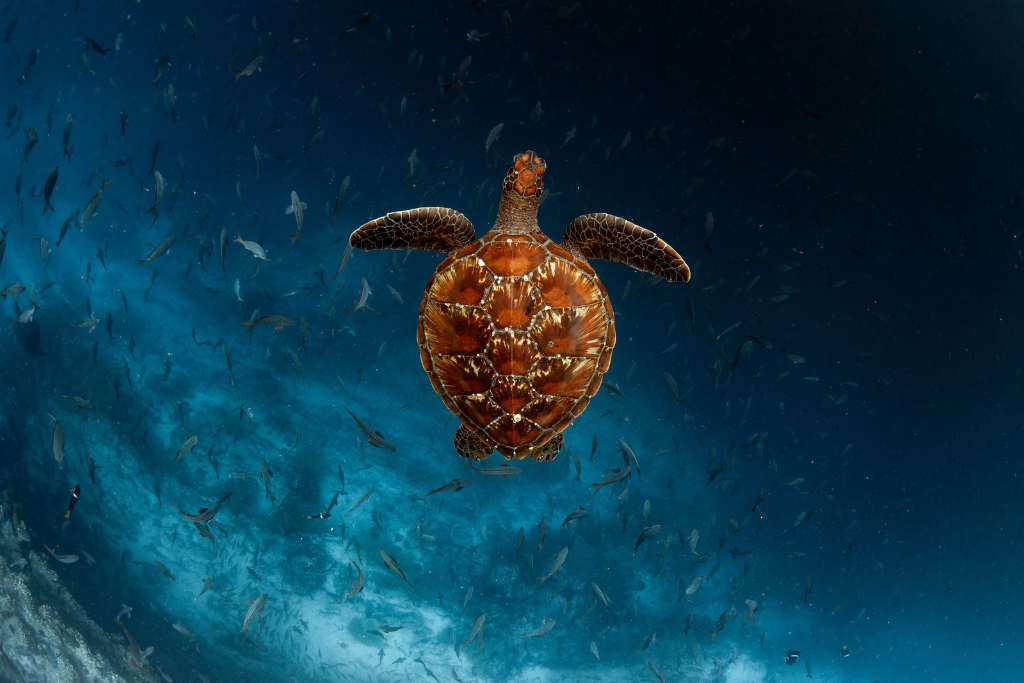
We return from our outings a little sun-struck, hair matted, slathered in sun protection, chattering like excited children as we compare our snorkeling treasures: a sea lion zipping past, a spotted eagle ray, a sea turtle gracefully moving its flippers through the water, schools of colorful fish, marine iguanas sprawled over black lava bubbled up from the belly of the earth.
The panga, the local term for our inflatable dinghy, rises and falls alongside the yacht. One at a time, we perform what I call “the dude grip,” an old trapeze artist trick: one arm grabs ours, then another, and in two swift, efficient moves, our crew has us securely back on board. It is a small piece of choreography, repeated several times a day, yet it comes to feel emblematic of the voyage. Like Captain Leo and the pride he takes in personally greeting each guest by name. More than a ritual. A statement. Every member of the crew knows each of us, our preferences, our routines. Someone helps unzip a wetsuit, reminds us to use sunscreen and hydrate, hands over a chilled towel to pat off the saltwater, offers tea or hot chocolate made with pure Ecuadorian cacao.
Luxury, I was once told, isn’t what you see on the surface. It is the thousand invisible gestures behind it: the hours, the skill, the backstage coordination that makes something feel seamless, easy, natural. In a capital city or on a fashionable beach, that level of service, if appreciated, is expected. In the Galapagos, some 600 miles off the Ecuadorian mainland, it is like Marcel Marceau conjuring an entire universe with the wave of a silent hand. Or pulling a 350-pound land tortoise out of a hat.
A World Still Becoming
The Galápagos owes its name to an old Spanish word for the giant land tortoises that still walk its dusty roads — some more than a century old, carrying another measure of time, their immense keratin shells. Sea lions occupy beaches, mangrove branches, even docks and dinghies with the confidence of creatures unafraid of humans. They see us and go about their day. They tolerate us. If we cross an unseen boundary, they let us know. Each species seems to know how to keep good boundaries. And if not, as we humans know all too well, that becomes an existential problem. This volcanic nursery straddles the equator like a rocky belt: 13 major islands and six smaller ones, scattered across a vast stretch of the Pacific Ocean. I can see it, but only one horizon at a time.
Aboard Evolve, I take a deep breath and look around. I am standing in my dream. I wonder if the young Charles Darwin, 26 years old when he sailed here aboard the HMS Beagle in 1835, drew a similar breath. What he observed on these islands would contribute to his theory that would change scientific thinking about the origin of species. Evolution is not an abstract concept tucked into a textbook. Here, we are walking around in it.
To be clear, I am not really a cruise-ship kind of person. And yet, here I stand on the youngest of Ecoventura’s three expedition yachts, wowed by the view. I have joined the Volcanic Wonders itinerary, an eight-day northern and western loop beginning and ending in San Cristóbal, with visits to Genovesa, Santa Cruz, Ferdinanda, Isabela, and Rábida. A week of exploring volcanic landscapes, marine habitats, and the extraordinary wildlife that has made these islands a living laboratory of evolution.
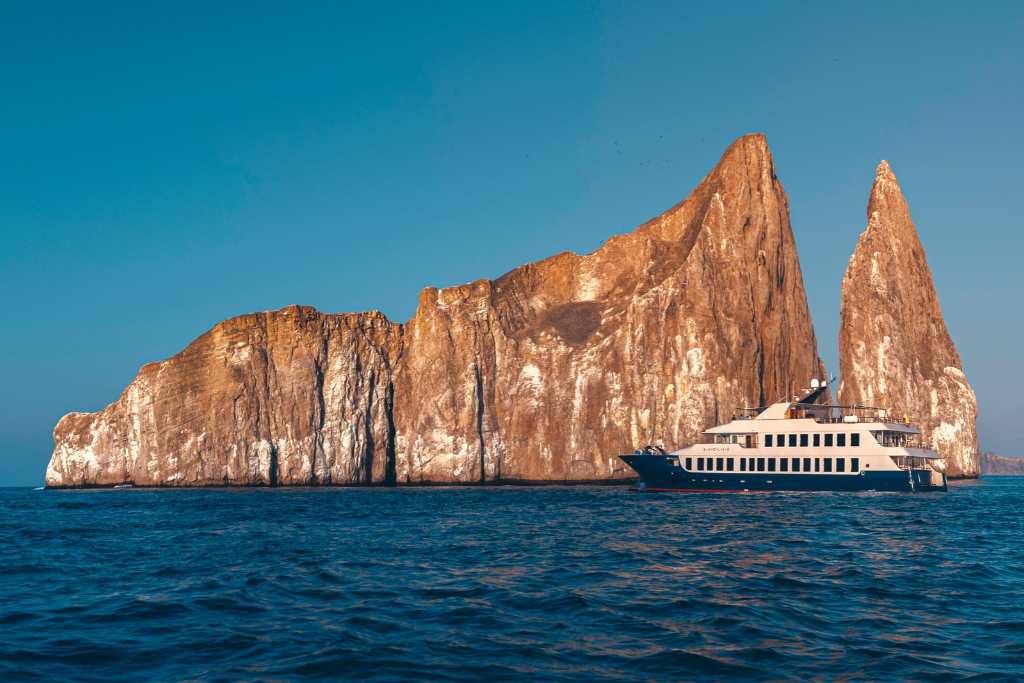
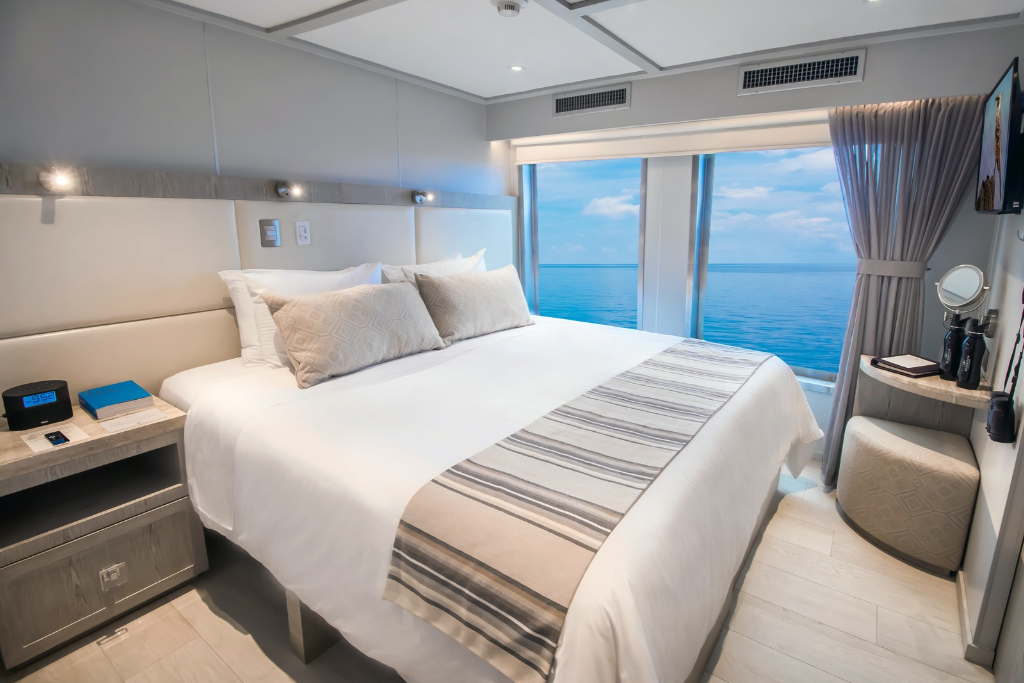
Evolve first sailed in 2023, joining her nearly identical sisters, Origin and Theory. They share the same lines, each with 10 similarly appointed state rooms. Each sail is limited to 20 guests who, for a week aboard, will be treated with the warmth and unfailing consideration of the Ecuadorian crew. The three yachts belong to the Relais & Châteaux collection, bringing its standards of hospitality and gastronomy into the expedition world. Ecoventura, an Ecuadorian family-owned company, has built its reputation on combining environmentally responsible discovery with luxury-level service.
And now, wellness.
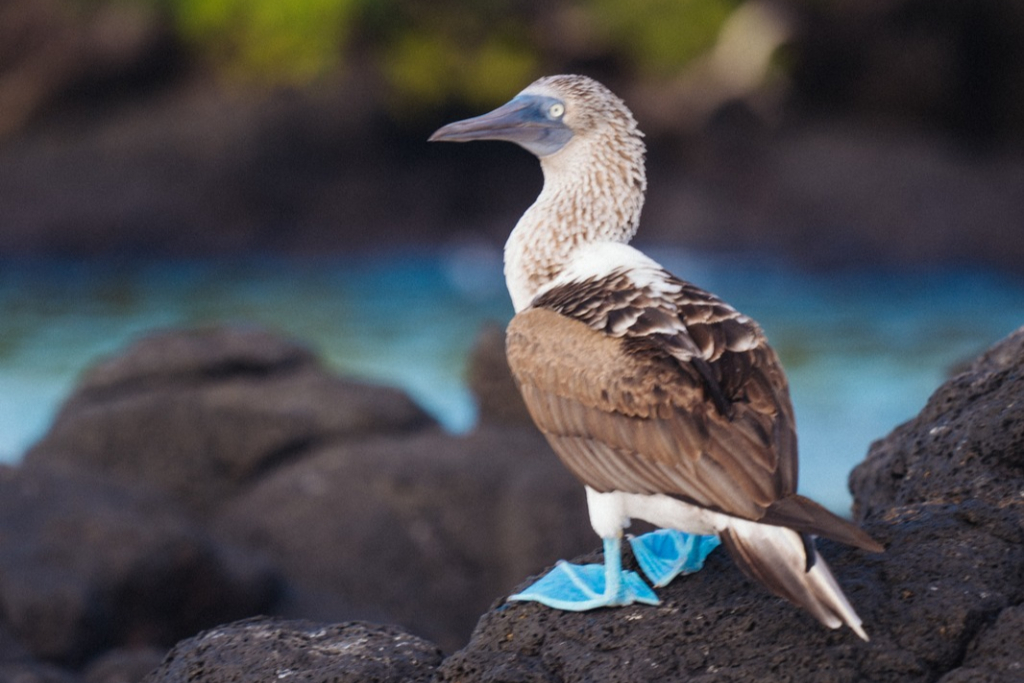
I have been invited on board to experience Evolve’s “ Wellness at Sea” program. Does wellness in the wild, at sea, require a different lens? A different standard? If so, what does wellness look like among the blue-footed boobies? The answer will require me to put skin in the game, wear a life jacket, and clock in some dusty kilometers of my own.
The Civilized Rhythm
“Expedition yacht” may suggest punishing wake-up calls and a permanently rushed timetable. Instead, Evolve has something of a summer-camp-for-adventurous-adults feel: carefully orchestrated, adventure-drenched days, a curated curriculum, enough free time to enjoy it, gourmet food, and a skilled crew that includes a dedicated concierge and two naturalist guides. Like the thread count, the guest-to-crew ratio is high.
This is an active voyage. Snorkeling is a nearly daily option, as is walking. It is neither a lie-on-the-beach holiday nor a dance-on-the-table cruise. If you cannot comfortably climb in and out of a Zodiac dinghy in sometimes choppy water, walk a trail in Equatorial heat, or feel comfortable snorkeling, this trip may not be your cup of café. But if you are relatively fit, you will have the time of your life.
Breakfast begins at seven or eight, with the first outing an hour later. Depending on the excursion, we prepare wetsuits and snorkeling gear, hiking shoes, water bottles, cameras, and binoculars. Our guides explain the terrain, the conditions, the dress code, and what to expect.
Far from the mainland, safety comes first, and love is a verb. Whether it is the captain, the helmsman, the guides, or the cabin crew, someone is always there to catch us, to hold us, to have our back. Aboard Evolve, the work has gone in behind the scenes so we can surrender to the wild.
Waiting on our return are drinks, snacks, and time to prepare for lunch, sometimes in the dining room, sometimes on the upper deck. Afterward, there is time to read, nap, journal, exercise, book a massage, or simply stand poised for the next marvelous thing that may pop up on the horizon. Several times a day, I seek out my stateroom, lie on my bed, and let the ship rock me into a drowsy, yummy alpha state. I often fall asleep with the book I’m reading on my chest.
The afternoon brings another round of exploration, this time in a new setting. Once we get the hang of it, we’re all nimbly snorkeling, kayaking, and asking our guides an endless stream of questions. By midweek, we have our routine down pat: prepare, discover, explore, return, eat, rest, repeat.
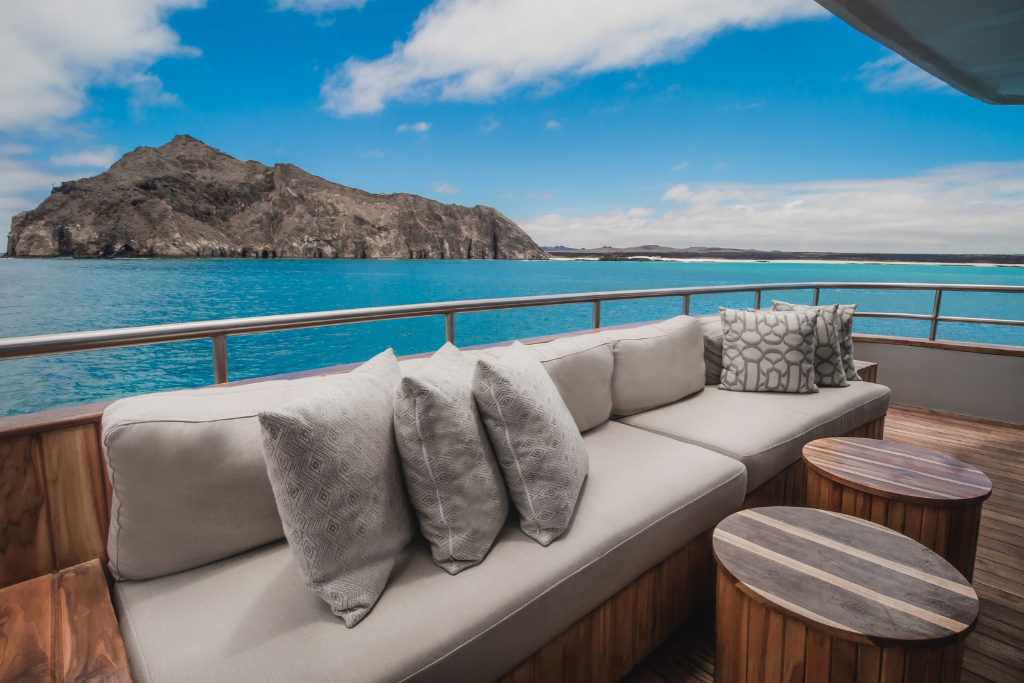
As the light softens each evening, we gather for sunset cocktails on the upper deck. Just us, the crew, and oh, the occasional Nazca bird. Out of wetsuits and hiking boots, the explorers club gives way to the social club. Linens and silks, not tuxedos and ballgowns. It’s time for the civilized rhythm, the aperitif with grazing foods, wine and a full bar. The caipirinha develops a particularly strong following.
Photographs circulate. So do stories. Almost immediately, the barmen know what each guest likes. Here, between a jacuzzi, a sunset, and a gently swaying boat (most days) surrounded by space and peace and the acknowledged good fortune of being here, we relive our day for one another. Just before dinner, our ship, surrounded by the night, beckons us to huddle, so our guides gather us in the salon. I love school, and as it turns out, everyone is as eager to learn as I am.
School in the Wild
Our onboard naturalist guides, Cécibel Guerrero (Ceci to all of us) and Fabrizio Prado, take turns briefing us on tomorrow’s landing sites and conditions. Power-point presentation at the ready, they offer visually compelling, fact-filled previews of the day to come. They explain geology and ocean currents, flora and fauna, history and park rules, fun facts, and anecdotes.
What the briefing doesn’t show is the design behind it. Every outing has its subset: volcanic fissures and tunnels, Palo Santo forests and candelabra cacti, the marine life, the birds, the reptiles, the mammals. And of course, the Darwin finches and mockingbirds. We learn how imported species brought in by mariners and colonists, goats and rats among them, nearly killed off the endemic ones.
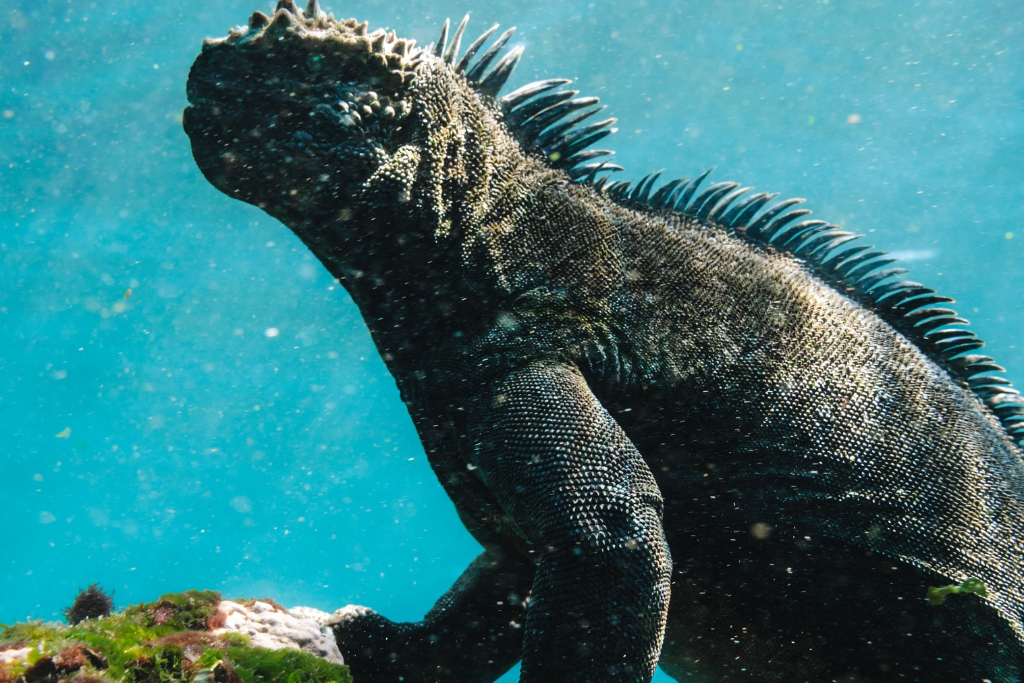
Their teaching is one of the deep pleasures — and great privileges— of the trip. The certification process for becoming a Galápagos park naturalist is rigorous, and it requires that to qualify for a spot, guides be not only Ecuadorian but also Galapagueńo by birth, marriage, or acquired right. They too, are endemic. Beyond curating our experience, they are ambassadors, entrusted by their country to keep this precious place precious.
The rules become part of our education: Stay on the path. Keep a two-meter distance between you and the animals. Touch nothing. Take nothing. Leave nothing behind. Pay it forward by applying what you learn here in your corner of the world. We can all get a little goofy in such proximity to wildlife. We come to our senses quickly enough. This is a UNESCO World Heritage site.
Here, belonging is not ownership. It is growing respect and mindful restraint.
Opera Sauvage
As dramatic as any opera, the Galápagos offers betrayal and deception, camouflage and strategy, territorial disputes and mating dances. The Galápagos does not edit out impermanence or imperfection, it gives it a stage. The wheel of life, spinning from birth to death and renewal.
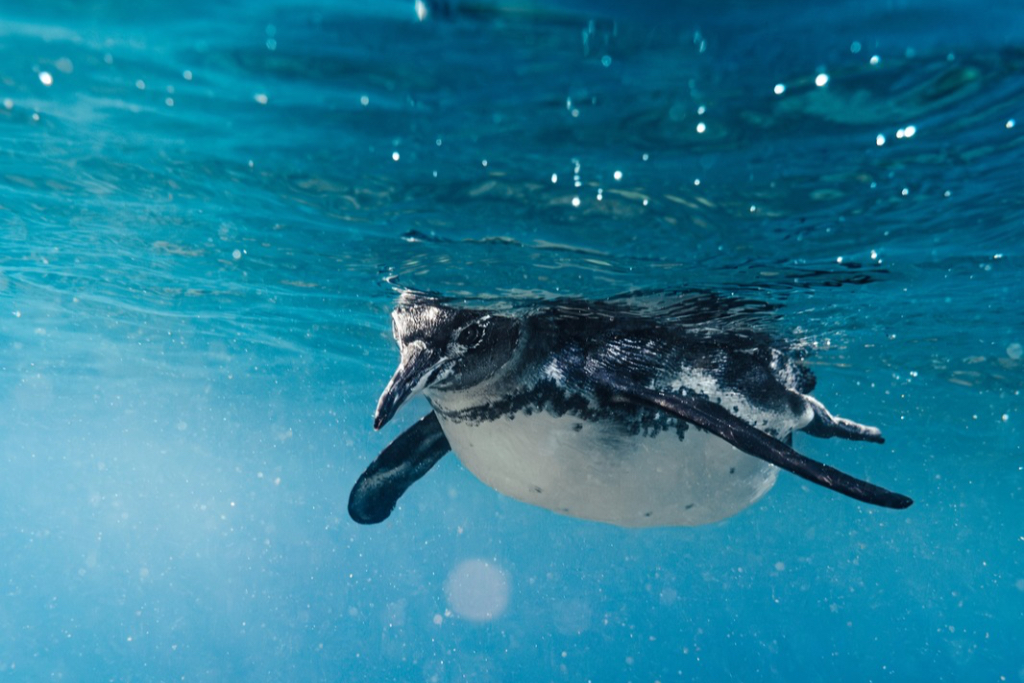
Céci speaks of hardship as an engine of adaptation, and here it is easy to understand what she means.Adaptation is not a self-help metaphor. It is life, conditioned by survival. The water and currents offer another lesson about cycles. The colder, nutrient-rich waters of the western islands support extraordinary marine life, including the Galápagos penguin, whose survival is vulnerable to changes in ocean temperature. This year, it’s a compounded El Niño year. Ocean currents shift temperatures, change weather patterns, and the low-lying Kelvin wave effect surfaces eventually to reach havoc.
Would we even see penguins? Their appearance on several occasions comes as a delightful surprise. Free from cage and zoo, released from the habits and confinements we’ve imposed on the captive kind, these endemic birds are free to be more of themselves.
Maybe we are, too.
Dining in the Wild
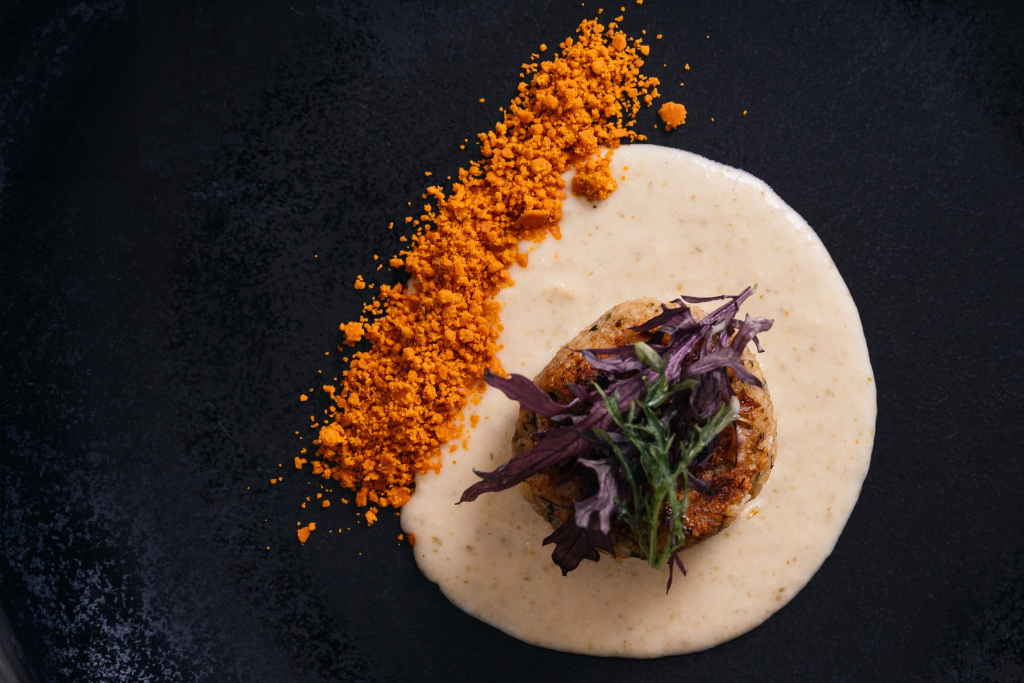
The cuisine is one of the yacht’s constant pleasures thanks to chef Arturo Peñafiel and his sous-chef, Fernando Lino. Fresh fish, shrimp, beef, pork, and chicken draw on Ecuadorian ingredients and flavors, international in sophisticated presentation, but bow low to national dishes: shrimp ceviche, seafood stews, humitas, fresh cornmeal patties steamed in their husks. There are coastal and highland vegetables and grains, delicious exotic juices like the pressed raspberry juice or the green detox.
As someone who is lactose intolerant, I notice another form of care. Alternatives arrive without fuss. I am not singled out; I am looked after, as if my restriction were an invitation for culinary creativity. The desserts pose their own sustainability challenge: how many can you reasonably eat in a week. Pannacotta, crème brûlée, the native Ecuadorian flan, apple tart. My dairy-free self finds ecstasy in the pineapple, a palate-pleasing explosion. And for the almost perfectly healthy who need to sneak in a naughty little treat, the Oreos.
At meals, there is another treat: the passengers. I am traveling alone. We are 17 in all and, as is typical on Ecoventura sailings that are not private charters, everyone else has come as a couple or in pairs as a group of travel-compatible friends. It’s Noah’s Ark, two by two.
And me.
My shipmates, four Australians and the rest American, are all in fine spirits and good shape. Worldly, 50ish plus, some silver haired, all seasoned travelers. Everyone is accomplished, open-minded, friendly, inviting, and a few are wickedly funny. Which makes for some great conversation and exchanges.
On the first evening, people invite me to their tables out of politeness or convention. By the second night, we have become an onboard community of friendshipish-ness. On a small boat, the social scaffolding comes down quickly. It’s one of the great things about a yacht this size. Who saw the ray? One shark or two? Someone has the best photograph. Someone else missed it completely. One guest celebrates her husband’s birthday, we all put on the pointy birthday hats, and sing. We are Evolve-ing, for our week at sea, into our own little sub-species.
Wellness in the Wild
A massage therapist is sailing onboard, only the second time Ecoventura has added one. The menu includes facials, hand and foot care, and different types of massage. But I wonder, does massage a wellness program make? I am not a skeptic by nature, still, I remain a little skeptical.
Interestingly, none of the passengers I spoke with chose this departure because it was a wellness sail. They came for the Galápagos, because the dates suited them, because someone they trusted recommended Ecoventura, because of its Relais & Châteaux affiliation, or simply because of the math. Twenty passengers means no wait times, no lines, and no competition for food at the breakfast buffet. There is also the ease of booking. The reservations process is straightforward and fully supported, taking much of the guesswork out of planning an expedition to a remote destination. That, too, is a luxury. Aboard, everyone gets the good room. Nobody has to negotiate for the better view or resent the friend who scored the superior suite. Wellness at sea, in other words, is something they bump into.
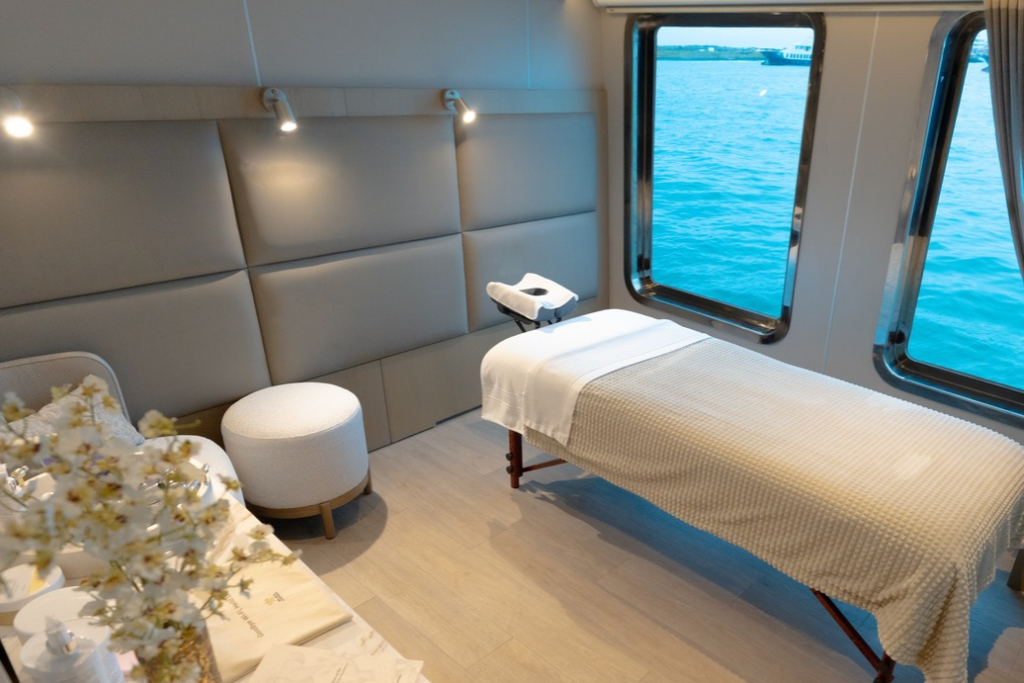
After a morning of hiking and snorkeling, a deep-tissue massage is a plus. The majority of the guests all book a treatment. They spread the wellness word. The therapist is great, and they all emerge smiling and relaxed.
I, on the other hand, emerge from my treatment a pale shade of green. The experienced therapist, professional and kind, keeps checking in about the pressure, the depth, the area. Half way through the hour, I am clenching my glutes for the next swell. My advice to future guests is simple: if you tend towards seasickness, as I discover I do, book your massage while the yacht is anchored. And, pack the Dramamine.
The compact gym fits into the equation. Like other animals, humans bring their routines with them: some time on the stationery bike, a stretch or a free weight curl. Keeping those small appointments with ourselves makes it easier to set the rest aside. Disconnecting is encouraged, never imposed. Call home, check in with the office, look over your emails, then, heed the call of the wild.
It’s a choice.
Our superb concierge, Estefanía Alava, puts it plainly. “Don’t come to work too much. These islands are incredible, and you will want to take back memories”. The old carpe diem magic trick. The beige pochette we each receive says it another way: “ Offline is the new luxury.”
Beyond the Self
One morning, the panga glides through mangroves. The day couldn’t be more beautiful. Sea lions drape themselves over low-lying branches, back from a long swim. Turtles surface and disappear. The penguins perform the morning show. Then, the helmsmen cut the engines. For a few minutes, there is no lecture, no photo op, no rush to name or identify. Just this quiet. This presence. Meditation for the reticent. Later, I opt out of kayaking. A persuasive wellness lesson is permission to pause.
Captain Leo tells me the wellness offering grew partly from guest feedback: requests for onboard massage, more non-alcoholic options, small ways to feel better while traveling. The offering stays modest. Evolve does not pretend to be a destination spa. The massage is a nice touch. The real treatment is elsewhere.
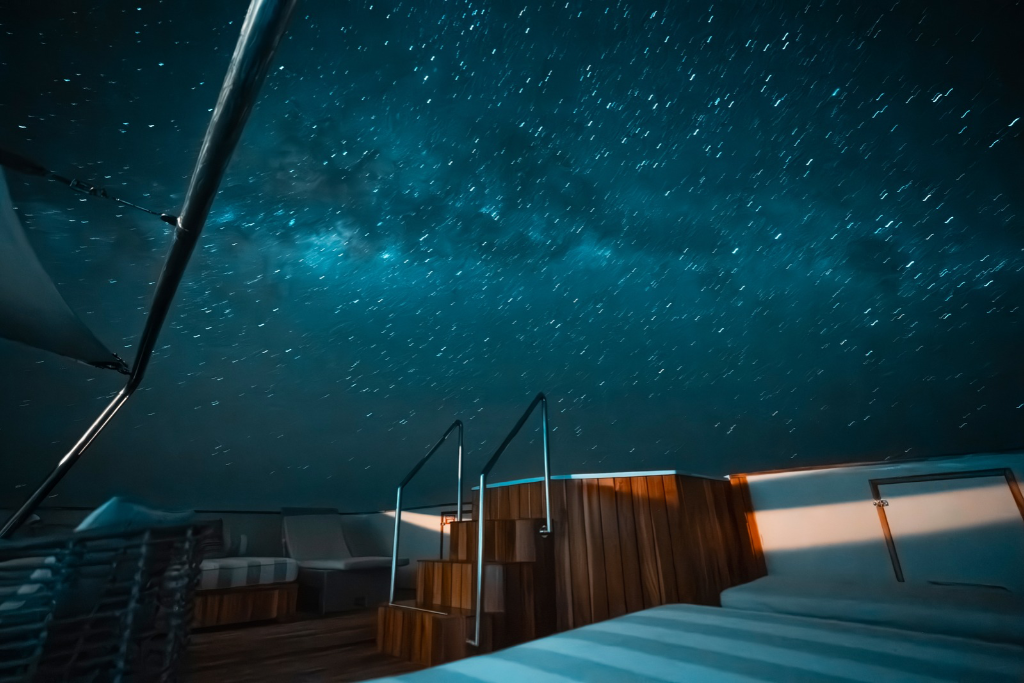
It is the attention to breath when you are snorkeling. It is observing the world around you and within. It is eating well and lingering over meals to speak with new friends and old. It is stargazing on the upper deck or relaxing in the jacuzzi in the expansiveness of the Pacific Ocean.
There is the runaway moment of bliss I had while snorkeling in insanely clear water, following a ray, when a shaft of light streamed through the water and pierced me as I made my way up to the surface. And there was a moment of pride while, when snorkeling with the group, I spotted a shark. Instead of panicking or giving in to fear, I swam with it, amazing grace.
Enlightenment, like breakthrough, or curiosity or deep awe, is not just conceptual. It is embodied. Wellness starts with addressing that person. That coming home to oneself. It’s intriguing and absorbing. My body, my sleep, my food, my stress levels, my longevity, my metrics. My life vest.
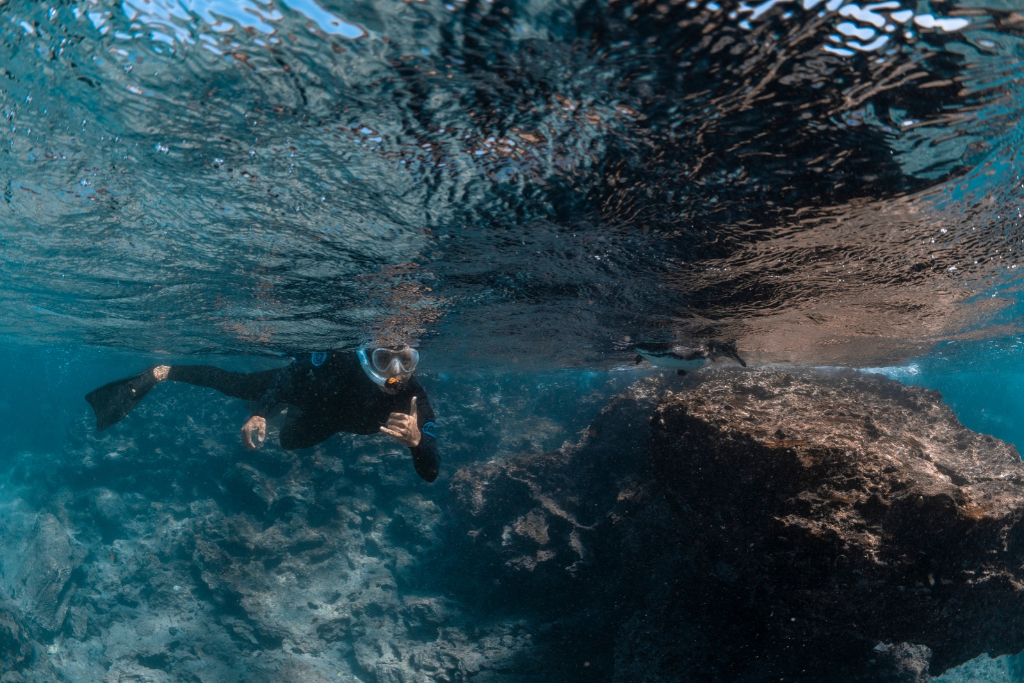
But what happens when care moves outward? What happens when we raise our gaze to include the world and all the wonderful things in it? Our guides have been teaching us this all week long. Attention. Pause. Space. Respect for the lives around us. Perhaps wellness is not only about caring for ourselves, but learning that we are not the center of the universe. We are part of it.
Six Crossings
By the time Evolve returns to San Cristóbal, we will have sailed 507 nautical miles and crossed the equator six times. Captain Leo tells us of a legend: each time you cross the equator, you become an entirely new person. South of the line, he jokes, he is Leo DiCaprio; north of it, Brad Pitt.
Six crossings. Six chances to become someone new. That may be asking a lot of a “Wellness at Sea” week. Still, I like the idea. Wellness at sea as the continual chance to begin again. To treat a life, or a day in it, as something that can still morph and change and become, just like these islands. To wake and find yesterday’s shore gone, another one to be discovered. Learning to care for the self is a vital first step. But caring for the world beyond it?
Now, that’s wild.
Feature image by Ollie Clarke, courtesy, Ecoventure.