Madrid is rightly proud of itself. The Spanish capital is stylish, effortlessly elegant, and unlikely to ever be accused of trying too hard. It welcomes tourists, of course, but there’s relatively little Disneyfication going on here, especially compared to other destinations in the Iberian Peninsula. That means it has a rhythm all its own — dinner is rarely before 10 pm, clubs open around 2 am, and somehow madrileños are filling neighborhood cafés to sip their morning café con leche just a few hours later.
That refusal to become a caricature of itself also means that Madrid doesn’t really revolve around a tourist center. Or maybe it has one, but it also has a collection of other districts that have formed for locals but also appeal to the curious traveler. Between them, they contain world-leading museums clustered together within walking distance of one another, a booming restaurant scene, and neighborhoods with distinct identities that make the choice of where to stay an important one.
In fact, Madrid may be best understood not as a single city but as a federation of neighborhoods, each with its own energy, food culture, and reasons to want to know it more. And while it’s true that the city is reasonably walkable and compact, and that it has an excellent metro that puts nearly everything in easy reach, the decision of a home base is worth taking seriously. Proximity matters, atmosphere matters, and the choice of neighborhood shapes how a trip actually feels. (And let’s be honest: You’ve probably come to Madrid to feel something, as the city doesn’t exactly lend itself to checking a list for sights seen).
Lots of other city guides will still tell you what you can see and where. Ours is different. We’re thinking about how you’ll feel. We drew on our own extensive travels to Madrid and tapped into a network of trusted friends and collaborators who call this city home. Our picks for hotels, restaurants, and shopping are based on where locals actually go, whether that means as their neighborhood hangout or as a destination that merits a trip across town. Together, they represent the best of Madrid for discerning travelers — from the gilded grandeur of the historic center to the polished boutiques of Salamanca, the museum mecca of Paseo del Arte, the literary bars of Barrio de las Letras, the charm of La Latina, and the creative buzz of Chueca.
Centro & Gran Vía
Centro is where Madrid announces itself most emphatically. Gran Vía — the wide boulevard that’s sometimes called the Spanish Broadway — cuts through the neighborhood with theaters, flagship stores, and some of the most photographed facades in the country. A few blocks away, Puerta del Sol is Spain’s symbolic center, and the adjacent Plaza Mayor is one of Europe’s best public squares. It’s fully enclosed by historic redbrick buildings, and it’s still used by madrileños every day. The Royal Palace and the Teatro Real form the western edge of the neighborhood, while pedestrian streets and small plazas connect everything else. Centro is best for first-timers, short trips, and travelers who want maximum landmarks with minimum planning. Here is where you’ll find the highest hotel density in the city, from the budget to the grand, lots of sightseeing can be done without using transport at all.
Places to Stay
Four Seasons Hotel Madrid — The neighborhood’s crown jewel—a beautifully converted 19th-century complex just steps from Puerta del Sol, with landmark dining, a rooftop bar with food from celebrity chef Dani García, and the city’s largest wellness center.
Thompson Madrid— A design-forward, five-star property occupying an entire city block between Gran Vía and Puerta del Sol, with a rooftop pool, a speakeasy-style piano bar, and Art Deco flourishes that give nod to the building’s cinematic history.
The Principal Madrid — Gran Vía’s first proper five star — a refined boutique property with a rooftop restaurant and terrace that offers some of the city’s best skyline views.
Metrópolis — New and trendy: A 19-room, boutique five star within a gorgeous Art Nouveau palace, that also includes a private member’s club.
Gran Meliá Palacio de los Duques — A meticulously restored 19th-century palace and former convent near the Royal Palace, decorated around Velázquez’s masterworks.
Places to Eat & Drink
Paco Roncero Restaurante —Set above the historic Real Casino de Madrid, this Michelin two-star restaurant is one of the city’s most accomplished fine-dining rooms.
Dani Brasserie at the Four Seasons — Forget what you think you know about hotel restaurants. The Four Seasons’ acclaimed all-day brasserie is one of the neighborhood’s best meals even if you aren’t staying at the hotel.
Lhardy — One of Madrid’s oldest and most storied restaurants—since 1839. There’s a full menu of old-fashioned fanciness, but go for the signature dish: their version of Madrid stew (cocido madrileño) with angel hair, chickpeas, chorizo, black pudding, truffled sausage, Iberian ham, Galician beef shin, crispy pigs’ ears, and more.
Estimar — Chef Rafa Zafra’s celebration of Catalan coastal seafood: impeccably fresh fish and shellfish sourced daily, served with restraint and clarity in a golden-hued room.
Ático — The rooftop of the Principal is more than an ordinary hotel restaurant. Its stunning views over the city are matched by its competent menu of Mediterranean dishes.
Bar Manero (Marqués de Cubas) — A sexy, exuberant dining room and a shamelessly indulgent menu that goes heavy on the caviar — guests are welcomed with a dollop on their hands — and raw bar.
Places to Shop
Gran Vía — Worth walking end to end at least once — flagship stores, impressive architecture, and the best window shopping in the city center.
El Corte Inglés (Preciados-Callao) — The Callao location of Madrid’s iconic department store is the most spectacular. The rooftop Club de Gourmet has panoramic views and a curated food hall.
Antigua Casa Crespo — This mom-and-pop espadrille shop packs a lot of history into its small square footage. It was founded in 1863 and is now overseen by the fifth generation of the same family, and it counts members of the royal family among the clientele for its colorful footwear.
Salamanca
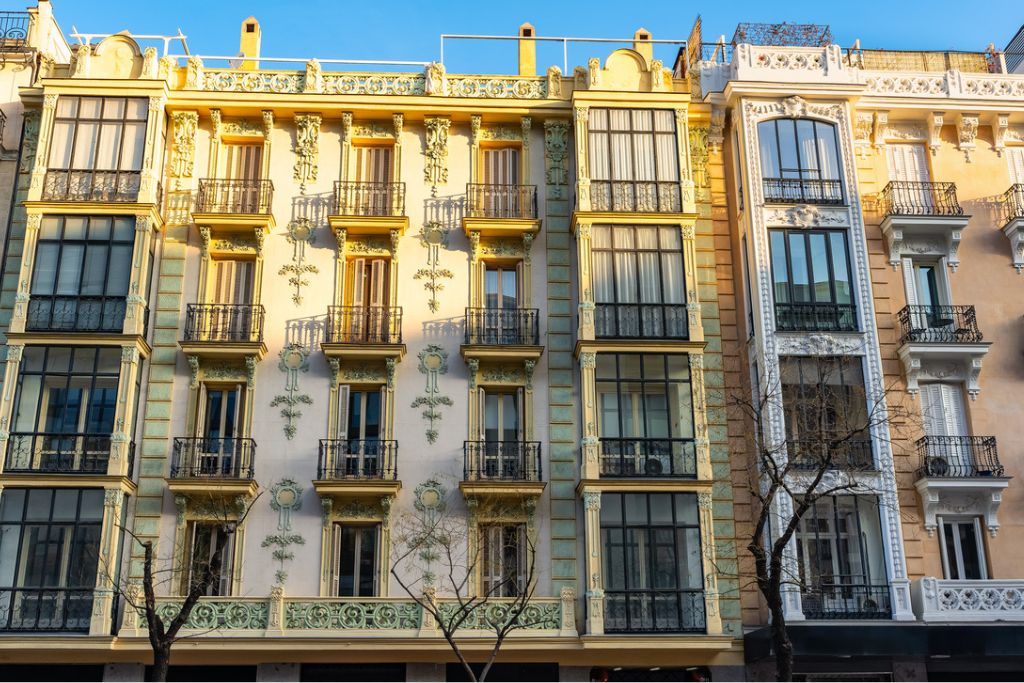
Salamanca is to Madrid what the 8th arrondissement is to Paris or Bond Street is to London. The neighborhood was built in the late 19th century for the Spanish aristocracy, and its grid of wide, tree-lined streets still operates as the city’s luxury hub. Calle de Serrano — the Golden Mile — is where Loewe, Gucci, Louis Vuitton, and Chanel maintain flagship boutiques alongside Spanish houses of genuine prestige. The adjacent streets (Velázquez, Ortega y Gasset, Claudio Coello) offer a more subtle, often better version of the same: independent boutiques, curated multi-brand stores, and restaurants that attract the city’s smart set. Salamanca is right for visitors who appreciate shopping, fine dining, and a residential calm. Hotel options skew toward refined boutique rather than showy grand palace, and the dining scene has more Michelin stars per block than almost anywhere else in Spain. The tradeoff is distance from the historic center and fewer low-key restaurant options.
Places to Stay
Rosewood Villa Magna — A landmark on the Paseo de la Castellana, the Rosewood embodies residential-style luxury. Its 154 rooms and suites, four dining concepts, and spa all have a design that respects the building’s aristocratic heritage.
Hotel Único— An intimate, 44-room boutique hotel set in a 19th-century palace on Claudio Coello. A walled garden, a spa, and a bistro-style restaurant make this feel like a very well-staffed private house.
Bless Hotel Madrid — The Golden Mile’s most fashion-forward address, thanks to stunning interiors by Lázaro Rosa-Violán with an emphasis on 1970s tactile glamour. The rooftop pool and sky lounge attract a well-dressed, nightlife-oriented crowd.
Heritage Madrid — A 46-room Relais & Châteaux hotel designed with Belle Époque elegance by Lorenzo Castillo, with parquet floors, jacuzzi suites, and the Michelin-starred Haroma restaurant led by chef Mario Sandoval.
Places to Eat & Drink
Ramón Freixa Atelier — Salamanca’s most coveted reservation: 10 seats at a U-shaped dining counter around an open kitchen, two Michelin stars, and an avant-garde tasting menu. Intimate, theatrical, and extraordinary.
Ten Con Ten — A Salamanca institution— part brasserie, part private club energy. Traditional Spanish cooking, a very local crowd, and the kind of comfortable elegance that makes you want to stay for hours.
El Pescador — A tímeless marisqueira, or seafood hall, whose decoration seems not to have changed in decades. No matter: Neither has its menu, as there’s no point in messing with the perfection of super-fresh fish and seafood, whether from the extensive raw bar or kissed by the fire of the grill.
El Patio del Claudio — Upscale and elegant bistro fare within a stylish dining room and sunny garden inside Hotel Único.
Places to Shop
Loewe — Spain’s greatest leather house, now a global icon. The Serrano flagship occupies a particularly beautiful space and carries the full women’s, men’s, and accessories collections.
Atelier Concept — A curated multi-brand boutique carrying European and Spanish designers that the Serrano flagships don’t; it’s the most fashion-forward shopping in the neighborhood.
Cortana — Dreamy, willowy ready-to-wear women’s fashion made by hand from premium natural fabrics (silk, linen, and cashmere) in small ateliers in Barcelona and Mallorca, the home base and inspiration for designer-founder Rosa Esteva.
Jerónimos & the Paseo del Arte
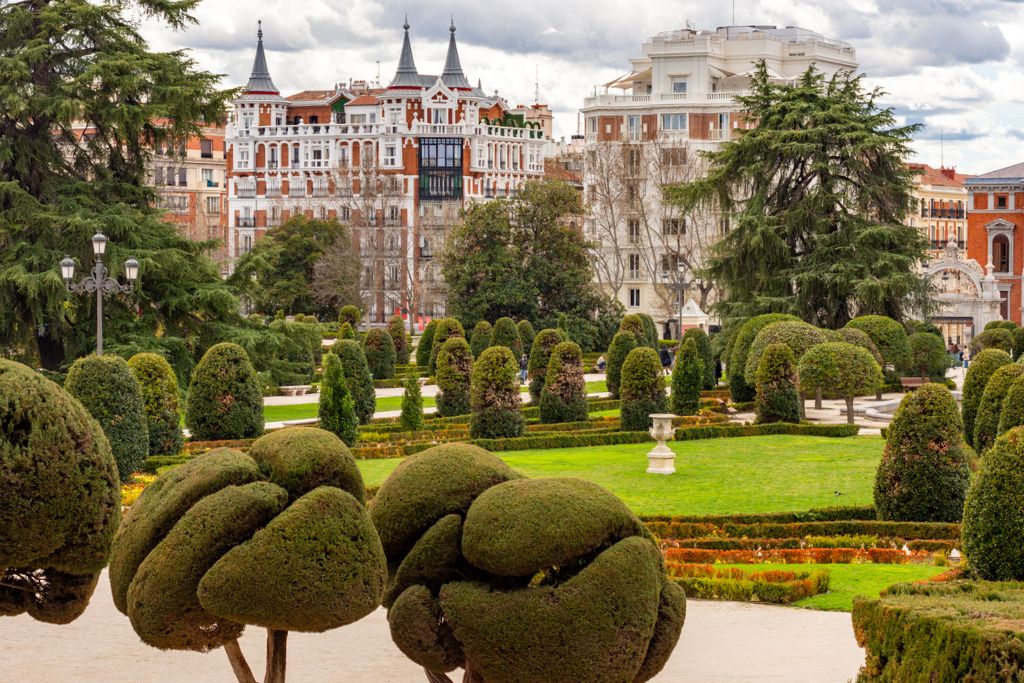
The Paseo del Prado, a UNESCO World Heritage Site boulevard lined with neoclassical buildings, gardens, and fountains, is one of the most beautiful streets in Europe. And that’s before you start going inside the museums. At its southern end sits the Reina Sofía, home to Guernica. Midway up, the Thyssen-Bornemisza showcases one of the world’s great private collections. At the top, the Prado stands as the heavyweight: more than 8,000 works by Velázquez, Goya, El Greco, Raphael, Rubens, and Titian. Add the adjacent Retiro Park — a 350-acre green lung with a crystal palace, a boating lake, and gracious gardens — and you have the city’s most culturally dense quarter. This neighborhood is right for art lovers, museum-intensive itineraries, and travelers who want classic, grand-hotel luxury. The downside is that nightlife and casual bar hopping require a cab or metro to somewhere else.
Places to Stay
Mandarin Oriental Ritz, Madrid — The legendary Belle Époque palace across from the Prado, built in 1910 to host royalty and dignitaries, was reimagined by Mandarin Oriental with a full restoration of its glass-ceilinged rotunda, a sexy Champagne bar, and restaurants and bars led by esteemed chef Quique Dacosta.
Hotel Palacio del Retiro — An Autograph Collection property in a renovated 1910 palace beside Retiro Park with 51 rooms, refined interiors, and a Spanish-accented afternoon tea.
The Palace, a Luxury Collection Hotel — A recently restored 1912 landmark with a spectacular stained-glass dome, 470 handsome guest rooms, and a cocktail bar paying homage to the Generation of ’27 poets. Ernest Hemingway set parts of The Sun Also Rises here, and other patrons included Picasso and Dalí.
Hotel Urban — A five-star contemporary property with a strong design identity. Its Southeast Asian art collection and dark, opulent interiors make it one of Madrid’s more atmospheric stays.
Places to Eat & Drink
Deessa — Quique Dacosta’s Michelin two-star restaurant inhabits the Ritz’s most beautiful gilded salon. Two extended tasting menus tell a sea-and-land story with sculptural plating that makes it one of the loveliest fine-dining experiences in the city.
CEBO — Javier Sanz and Juan Sahuquillo put peak-season ingredients in a starring role in precise, contemporary cooking at their compact fine dining restaurant within the Hotel Urban.
Las Terrazas del Thyssen — The gastronomic space within the Thyssen-Bornemisza is a cut above the standard museum restaurant, and its terrace is a delightful place to pass a couple of hours while museum hopping — especially while sipping one of the craft cocktails inspired by works in the collection.
Places to Shop
Tienda Prado — The museum shop at the Prado is one of the best in Europe, with high-quality reproductions, art books, design objects, and thoughtful gifts that don’t feel like tourist souvenirs.
Tienda Thyssen — A curated selection of art books, prints, and accessories that reflects the collection’s breadth and quality. Particularly strong on 20th-century design.
Calle de Claudio Moyano — A row of outdoor bookstalls near Retiro Park that’s been offering secondhand and antiquarian titles for more than 100 years.
Barrio de las Letras (Huertas)
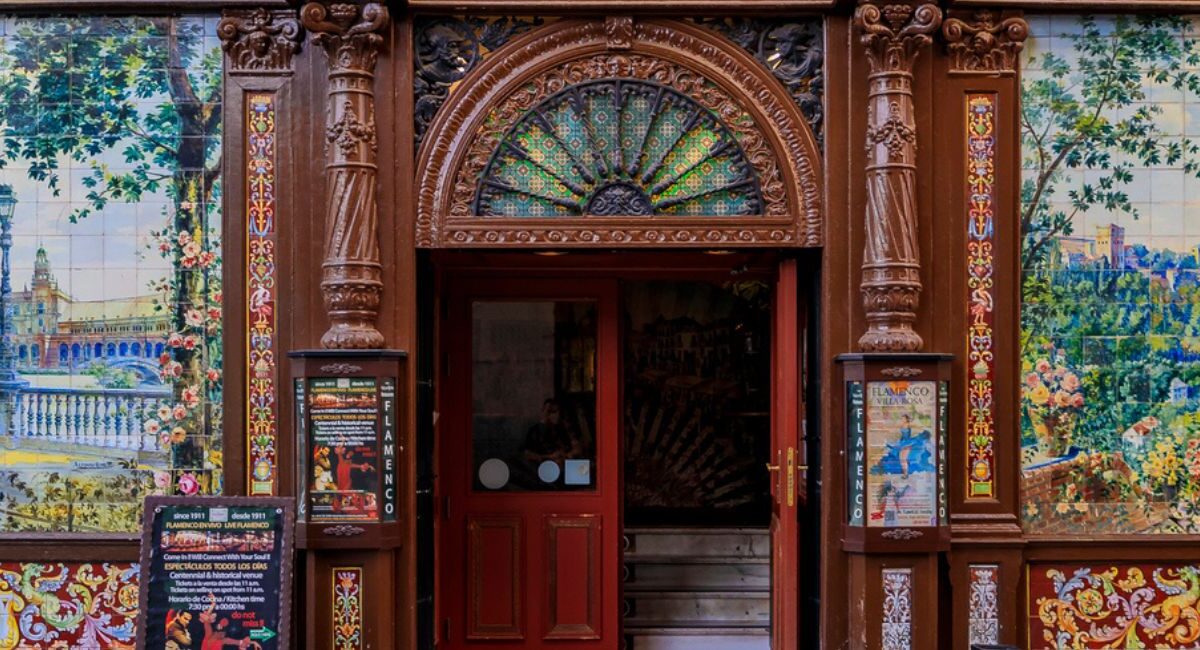
Barrio de las Letras — the Literary Quarter, also known as Huertas, after the main street — is where Cervantes wrote Don Quixote and Lope de Vega staged the first Spanish plays. The streets are inlaid with quotes from Spanish literature, and the atmosphere remains distinctive: bohemian but not scruffy, historic but not a time capsule. The heart of the neighborhood is Plaza de Santa Ana, which is ringed with café terraces and among the most sociable squares in Madrid. Calle de las Huertas, Calle del León, and the surrounding streets are lined with wine bars, innovative small restaurants, and the occasional flamenco venue. The neighborhood suits travelers who want culture, good food, and atmosphere in one compact area without the tourist density of Centro. It’s a short walk from the major museums, and its proximity to Lavapiés (the city’s most multicultural neighborhood) adds texture and creative energy.
Places to Stay
Gran Hotel Inglés — Madrid’s oldest hotel (1886) has been fully modernized with interiors by David Rockwell and an afternoon tea that honors its literary history. (Virginia Woolf was among the authors who stayed here.) Forty-eight rooms, a beautiful lobby, and a location in the heart of the district.
NH Collection Madrid Palacio de Tepa — The hotel was built for the Earl of Tepa, the last viceroy of Spain in Mexico, and even with its contemporary upgrades and five-star business-hotel sheen, it retains a sense of history. The rooms have stylish accents, and views of the Church of San Sebastián and Calle Atocha.
CoolRooms Palacio de Atocha — The 34 rooms at this 1852 palace-turned-luxury hotel are some of the biggest in Madrid. The hidden pool garden makes the hotel especially appealing during the hot Madrid summer.
Places to Eat & Drink
Salmon Guru — Consistently voted among the best cocktail bars in the world. Come early for pre-dinner drinks (it’s walk-ins only); stay much longer than planned.
La Venencia — A legendary sherry bar since 1922 — no cameras, no music, no cocktails, just extraordinary fino and manzanilla poured from cobwebbed barrels. Ernest Hemingway was a regular.
Taberna de la Daniela — A handsome, old-school taberna popular with neighborhood regulars for proper cocido madrileño — the city’s great stewed meat extravaganza — served in the traditional three-course sequence.
Places to Shop
Roberto Garrudo — Longtime purvey of well-crafted flamenco shoes and clothing, including embroidered shawls and pericón fans, as well as gear for Latin dance and ballet.
DOOC Atocha — A playful shop specializing in irreverent housewares like Seletti mouse lamps and paper scabbards, as well as irreverent charms and other fun jewelry.
La Integral — A showplace for independent and up-and-coming designers, selling everything from statement T-shirts and vintage political pins to punk LPs and 1980s-inspired fanzines.
La Latina
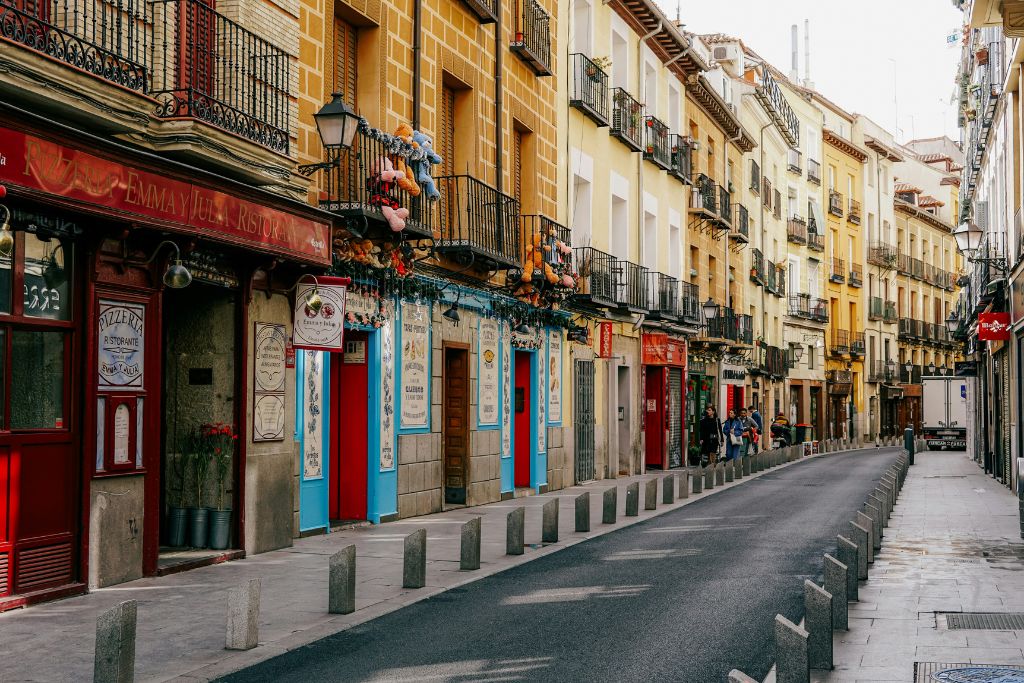
On a gentle slope west of Centro, La Latina is one of the oldest continuously inhabited neighborhoods in Madrid, a pleasant warren of narrow medieval streets, tilted buildings, Gothic and Baroque churches, and a topography that owes nothing to urban planning. The Jardín de las Vistillas has views across to the Sierra de Guadarrama, and the Plaza de la Paja is a gorgeous square with a hidden garden. Calle de la Cava Baja, the main artery, was built directly over Madrid’s old city walls; its buildings were posadas where merchants and travelers stayed in the 17th and 18th centuries. La Latina is also one of Madrid’s most beloved neighborhoods for food: Cava Baja is dense with tapas bars and traditional restaurants, and Sunday mornings are organized around the El Rastro flea market followed by vermouth and pintxos.
Places to Stay
Posada del León de Oro — A beautifully restored 17th-century posada on Cava Baja, with 17 rooms around the original interior courtyard. The most atmospheric address in the neighborhood.
Posada del Dragón — A sister property to the León de Oro with the same historic sensibility, a restaurant in an old soap factory, and a bar that draws neighborhood regulars.
L&H La Latina — Modern design hotel with compact but colorful rooms, all of which have their own kitchenettes, making it a good choice for longer stays.
Places to Eat & Drink
Txakolina Cava Baja— Pintxos are the Basque equivalent of Madrid’s classic tapas, and one of the city’s best selections is lined up along the counter at this Basque-style bar. Try them on a Sunday afternoon with a glass of txakoli wine.
Juana La Loca — A La Latina institution known for creative tapas, excellent tortillas, and the kind of relaxed neighborhood energy that makes a weekend afternoon fly by.
Taberna Almendro 13 — A classic tavern for plates of jamón, cured meats, and Manchego — always packed, reliably wonderful, and a quintessential La Latina experience.
Jardín de las Vistillas (terrace bars) — The elevated garden terrace overlooking the city’s rooftops is one of the best spots for a sundowner. There are several fairly interchangeable bars here; pick any of them, since you’re here for the views.
Places to Shop
El Rastro — Madrid’s legendary Sunday flea market, running weekly since at least the 15th century. Sellers along the main strip on Ribera de Curtidores and the side streets around it offer antiques, vintage clothing, records, art, and everything else. Arrive early.
Mercado de la Cebada — La Latina’s traditional covered market is less tourist-centric than San Miguel and shows a genuine version of how locals shop for produce, fish, and charcuterie.
Cocol — An effortlessly chic small boutique that elevates the art of the everyday. Everything from ceramics and textiles to leather bags and straw hats is made by an independent Spanish artisan.
Chueca
In the 1970s, Chueca was the center of la movida madrileña — cultural and social liberation that followed the end of the Franco era — and the neighborhood hasn’t entirely lost that energy. Today it’s a compact grid of vibrant streets north of Gran Vía. It is Madrid’s most inclusive district and one of its most creative, with a design-forward retail scene and a dining culture that tends to be ahead of the rest of the city. Nearby Calle Ponzano (technically in the adjacent Almagro neighborhood) has earned a reputation as the best restaurant street in Madrid. Chueca offers a taste of the way younger, creative madrileños actually live: eating late, moving between bars with no fixed agenda, discovering restaurants that opened six months ago and already have a following.
Places to Stay
Hotel Orfila — A Relais & Châteaux property in a 19th-century palace on a quiet residential street between Chueca and Alonso Martínez. With 32 rooms and a garden terrace, it’s one of Madrid’s most serene small hotels.
Urso Hotel— On the boundary between genteel Chamberí and trendy Chueca, in a historic building that still contains its original elevator, ceiling moldings, and stained-glass windows but pulls off the vintage-contemporary mix quite well.
Only You Boutique Hotel Madrid — A design hotel in a 19th-century palace with bold, contemporary interiors by prestigious interior designer Lázaro Rosa-Violán and a popular cocktail bar inside an old bookstore.
7 Islas Hotel — A warmly designed boutique in Malasaña/Chueca with an art gallery for itinerant exhibitions, strong neighborhood access, and a more intimate scale than most of Madrid’s luxury hotels.
Places to Eat & Drink
Casa Salesas — A beautifully designed café-restaurant on the Plaza de las Salesas that serves brunch, lunch, and dinner and is reliably good for all three. Later on, it turns into a cocktail bar with live DJs.
Los 33 — Sexy, low-lit steakhouse that’s having a major moment right now. Book well in advance.
Barrutia y el 9 — Cool in spite of itself, a no-frills tavern with tiles on the walls and classic dishes like peas with black pork on the tables.
1862 Dry Bar — The cocktail bar that helped transform Madrid’s drinking culture: classic but not nostalgic, technically excellent, and always worth a visit.
Calle Ponzano (tapas bars) — The street has been nicknamed “Street of Happiness” for its density of excellent tapas bars. It doesn’t really matter which one — or ones — you choose, as it’s popular to graze at a few over the course of an evening.
Places to Shop
Calle de Fuencarral — The axis of Madrid’s independent retail, a long pedestrian street that separates Chueca and Malasaña, lined with streetwear boutiques, concept stores, and vintage shops.
Casa Postal — A century-old stationery and postcard shop stocked with vintage prints, curiosity-shop items, and beautifully mundane objects that make perfect souvenirs.
Patrimonio Comunal Olivarero — A cooperative-run shop selling the finest extra-virgin olive oils from across Spain at fair prices.
More Neighborhoods to Know
Malasaña — The area north of Chueca across Gran Vía was Madrid’s counterculture heartland and remains a prime neighborhood for vintage shopping, independent cafés, and a younger nightlife scene. If Chueca feels a little too polished, Malasaña offers a rougher-edged alternative with excellent food, particularly on Calle del Pez and its surroundings.
Chamberí — Still further north than Malasaña, Chamberí is a neighborhood that pulls in many repeat visitors. It’s quiet, residential, and less tourist facing, but it’s home to some of the city’s best independent restaurants and the beloved Plaza de Olavide, a circular square surrounded by café terraces that feels like a secret living room.
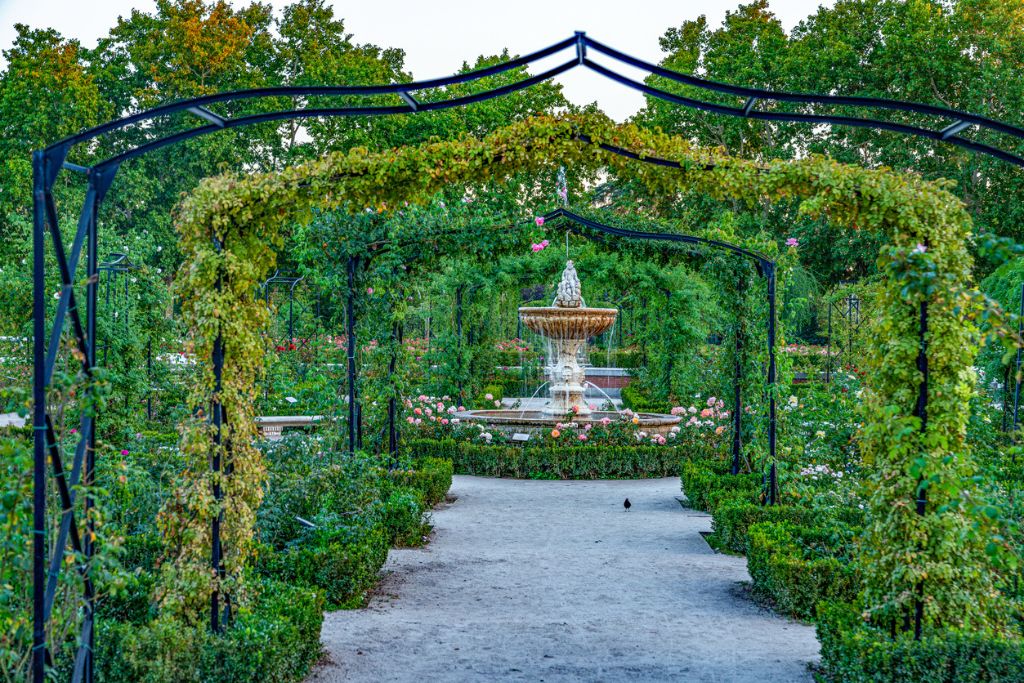
Retiro — The residential neighborhood surrounding the park of the same name offers a sedate, upper-middle-class calm. The park is one of Europe’s best urban green spaces.
Featured image courtesy SvetlanaSF via iStock. Travel Curator may earn a commission from booking links on this page.