I’d always accepted the idea of a once-in-a-lifetime trip without much interrogation. But when I started mentioning Bhutan — just casually, in conversation — something interesting happened. Nearly everyone responded the same way, Oh, that’s such a “bucket-list” trip. It caught me off guard, not because I disagreed, but because the unanimity made me pause. What were they really responding to? And what, exactly, earns a destination that kind of once-in-a-lifetime status? Each time I said I was heading to this magical, mythical kingdom — a sliver of a country tucked between India and China — faces lit up with that familiar mix of awe and longing. And while I understood the enthusiasm, it made me wonder why Bhutan, specifically, elicits that reflex. Is it the remoteness? The difficulty of getting there? The scarcity of people who have? Or is it something more human and intimate — an intrinsic knowing that a place might touch a deeper part of you, shifting things around in ways you won’t fully understand until you’re standing in the middle of it?
Bhutan, quite rightly, belongs firmly in that deeper shift category. It’s a trip that subtly rewires your interior world, leaving behind textures and patinas on your heart and mind that (in my case) continue to surface in everyday life. And honestly, if it weren’t for the gentle persistence of private travel designer Katie Terrington, I might never have known just how much this place had to show me. Katie takes an intuitive approach to travel, one that’s less about constructing itineraries and more about shaping experiences that feel emotionally resonant. “This is going to change your life,” she told me, and because I trust her implicitly, I packed my bags and followed her into the Himalayas.
A Country Measured in Happiness
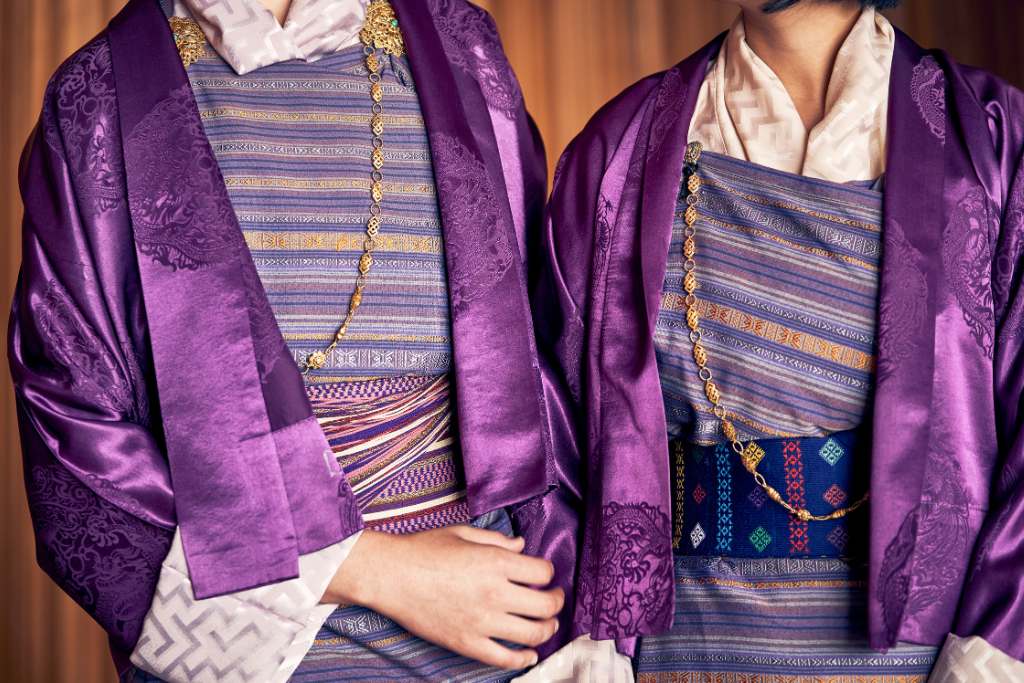
In Bhutan, wealth is measured not by GDP but by Gross National Happiness — literally. It is a national philosophy that sounds utopian until you start to understand its impact. Everything, from education to environmental policies to cultural preservation, ladders back to this idea that an entire country can be run with wellbeing in mind. Perhaps that’s why it’s not the easiest place to get to. High-value, low-impact tourism is the mandate. You can’t simply drop in. You have to be invited and vetted. You have to know the right people, or at least the right people who know the right people. In my case, that person was Katie, who often plots out Bhutan experiences for her high net-worth clientele. And once on the ground, she turns to Guides of Bhutan to take it from there. Our handlers comprised of Jigme, who masterfully shepherded us all over the country safely and with ease, the charming Wangchuk, who made sure we stayed on track with a kindness so effortless it almost didn’t register until later how much of an anchor he’d been. And, finally, Deki, one of only a handful of female guides in the entire country, and whom I felt instantly tethered to. There was something immediate and grounding about her presence — she genuinely floated on an air of calmness, met with a playful spirit, so soft yet commanding. Happily in their hands, I set out to explore this beautiful mystery of a country. I dotted my way across four regions — Thimphu, Punakha, Gangtey, and Paro — each one revealing a different texture, a different lesson, a different facet of what true immersion feels like.
Thimphu / Inhale
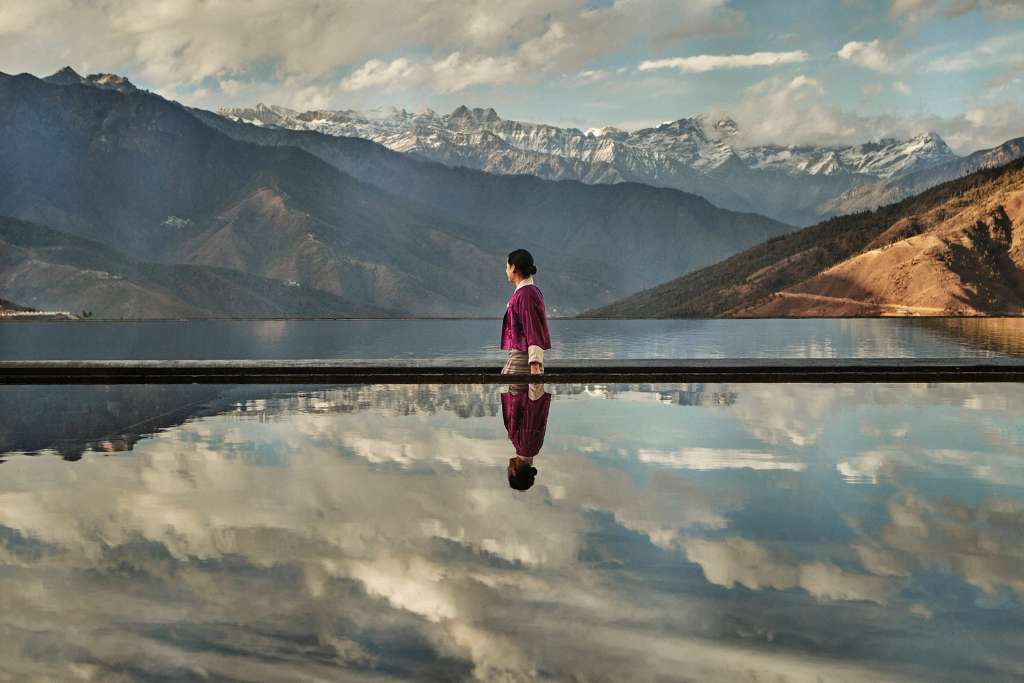
I started in Thimphu, Bhutan’s capital, and the only capital city in the world without a traffic light. (Its lone attempt was removed swiftly after residents preferred a policeman’s gentle hand signals over mechanized efficiency.) Hence, calling Thimphu a city feels slightly misleading. Yes, there is a vibrancy to it — a youthful energy pulsing through cafés and rows of little treasure-hunting stores — but that energy moves in poetic contrast to the cows roaming freely across intersections and the rhythmic chants drifting from nearby temples. Thimphu (and Bhutan in general) is a flow system. There are no rigid schedules, no frantic, “you’re five minutes late” reprimands. Here, time bends around intention, not urgency. The guides gently adjust the day based on your energy, the weather, a passing ceremony you might haphazardly encounter, or the fact that you really should stop for beers and momos (Bhutanese dumplings) because joy is a cultural requirement. The country is carbon neutral. Expansion is slow and deliberate. There’s a National Forestry Day where everyone plants a tree, and highway signs read: “No Hurry. No Worry.” It’s this duality that strikes you first. The sacred and the everyday share the same space so naturally that it recalibrates your sense of what modernity can look like. Teenagers in sneakers weave around crimson-robed monks. Prayer flags ripple above construction cranes. The scent of incense mingles with the smell of sizzling red rice noodles on street corners. And everywhere, the etched spine of the Himalayas frames the city like a protective cloak.
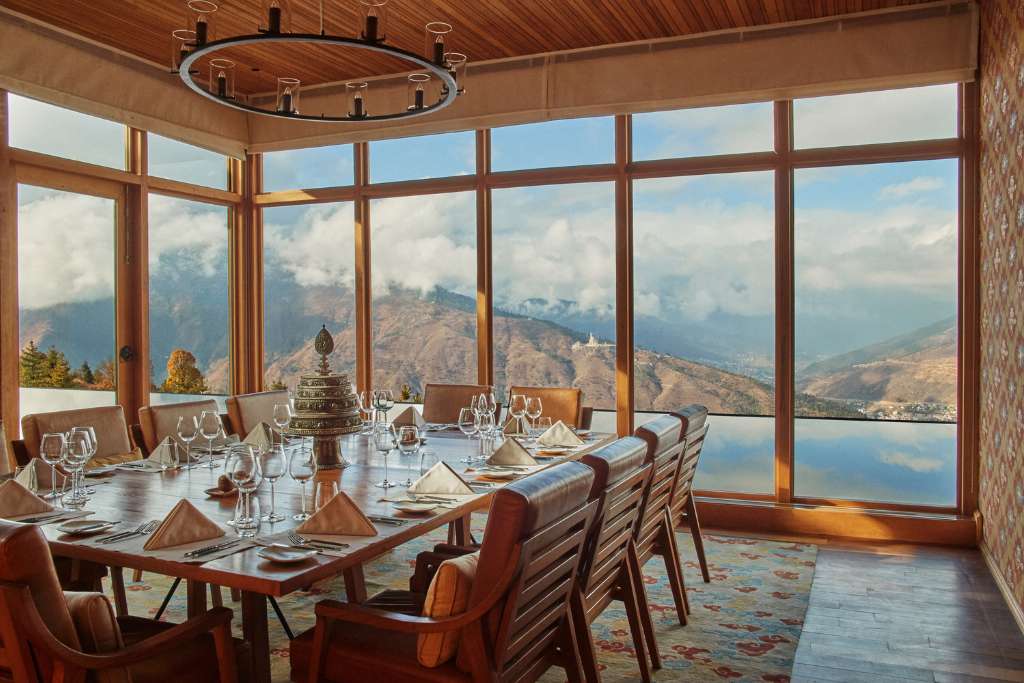
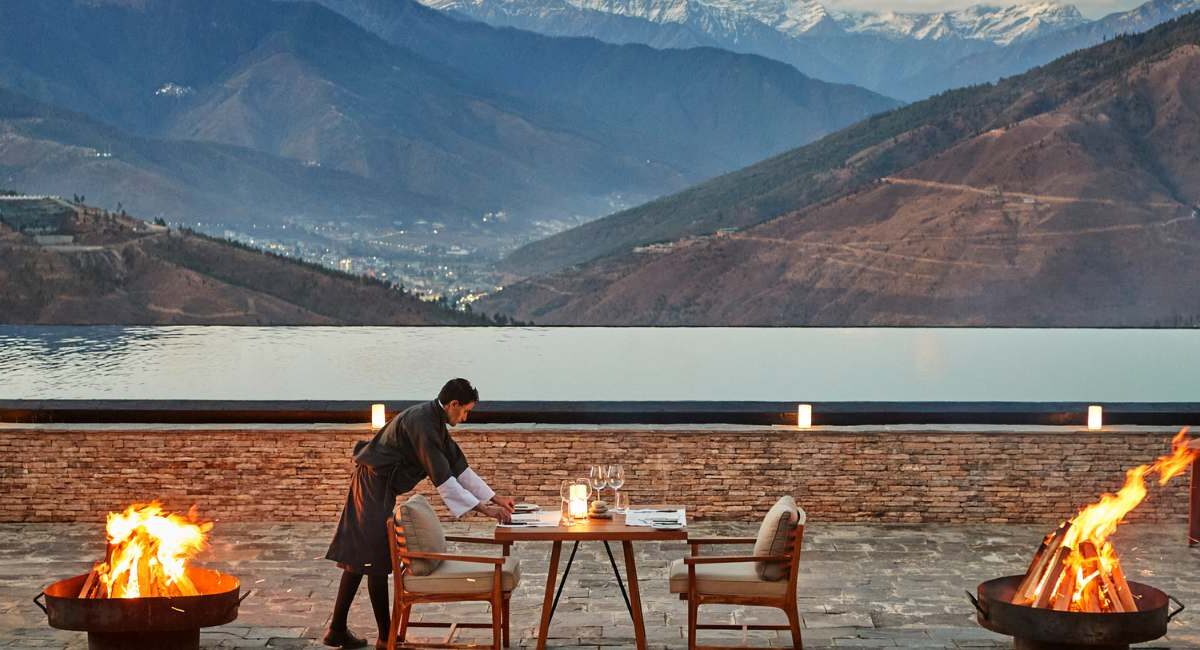
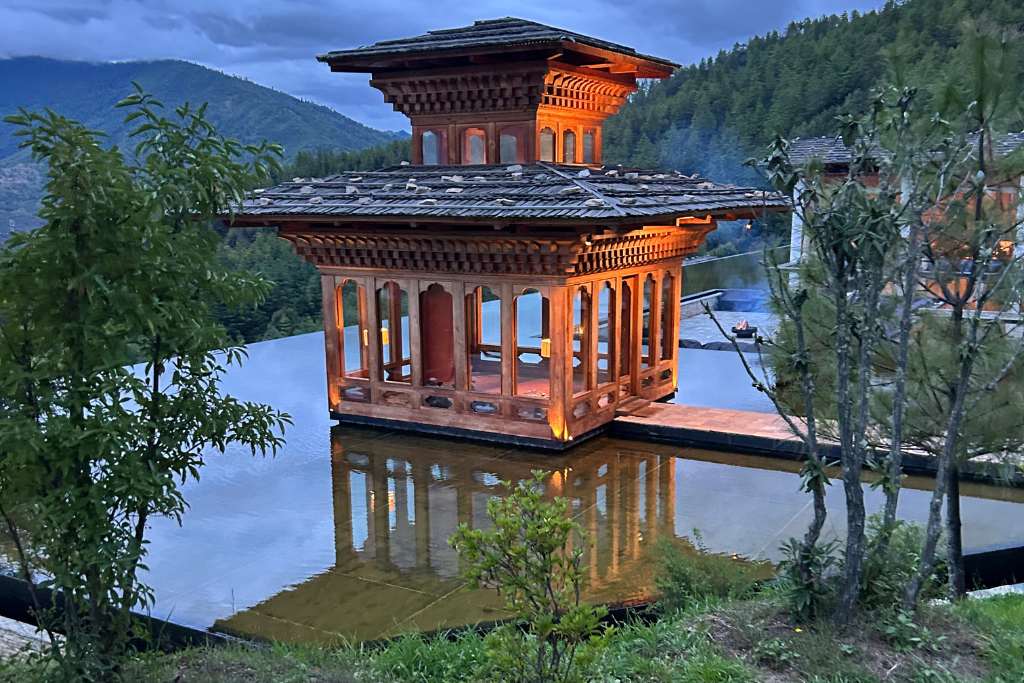
That first night, I called Six Senses Thimphu home. An Instagram favorite, for sure — but in person, it reads more like an architectural inhale where the absence of stuff is exalted above all else. The omission of unnecessary adornments creates conversation in its own right. Suddenly, these clean lines, long corridors, and quiet corners became as much a focal point as thought-provoking art or high-design furnishings would be anywhere else. But here, the properties’ minimalist, monastic, and restrained interiors support the local stonework and warm timber articulations that echo the surrounding hillsides. Every angle seems designed to point your attention outward, to the valley that unfurls below in layers of mist and pine forest. My room felt like a treehouse suspended between sky and earth — high enough to give the illusion of floating, grounded enough to feel safe and secure. I watched the city lights flicker from a distance, soft and scattered like fireflies, while the rest of Thimphu was a blanket of silent tranquility. This was the perfect starting point for shedding those self-inflicted Western stresses and begin embracing a quiet mind, ready to absorb something deeper. Here, in this capital of contradictions, I began to understand the idea of Bhutan as a place that doesn’t choose between old and new, but rather allows them to coexist in a kind of respectful balance. A preview of the equilibrium I’d soon find woven across the rest of the country.
Punakha / Exhale
If Thimphu was a gentle inhale, Punakha was the exhale I didn’t realize I’d been holding in for so long — probably years. This rugged riverside locale is unapologetically wild — lush, cinematic, a place where nature seems to swell outward in every direction. The drive alone felt like a rite of passage. Twists and turns clinging to cliffside edges, rivers charging through valleys with a force that vibrates in your chest, forests so dense and alive they seem to breathe with you. Quite simply, Punakha is an assault on the senses — one that dares you to venture outside those imaginary perimeter lines we tend to draw in our lives.
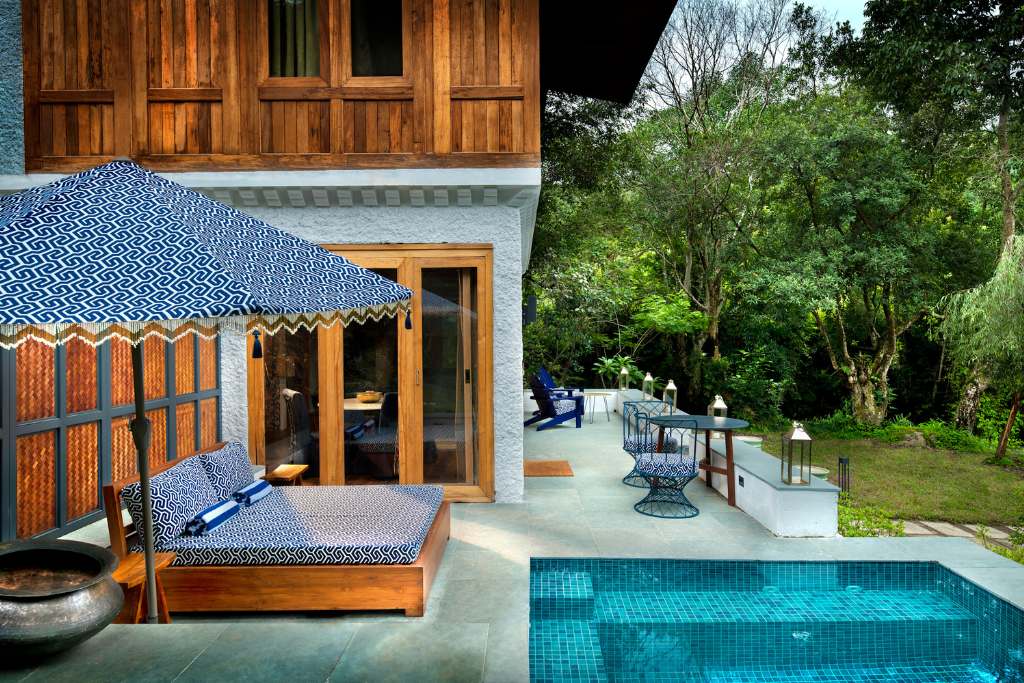
My home here was &Beyond Punakha River Lodge, where I resided in one of their luxury tents. These stunning structures are pitched at the edge of the river, and dissolve the boundaries between indoors and out. The canvas walls are soft thresholds that air moves freely through, and the property as a whole seems to hover in that enchanting in-between space where shelter and wildness meet, extending an invitation to stay curious. Stepping inside felt like stepping further outside. The interiors draw directly from Bhutanese craft, featuring local timber and stone, woven matting, framing techniques rooted in traditional century-old farmhouses, all interpreted with a contemporary clarity that allows the natural world to remain the true focal point. Mornings began with the scent of dew-heavy greenery drifting through the screens, the sound of the river stitching itself into every thought, the faint rustle of something in the trees, and trance-inducing, omnipresent chirps — a little reminder that you are very much a guest in this landscape. The lodge was built by local architects from Thimphu and is set across 50 expansive acres, yet it feels intimate, as though the land itself is holding a boundary around it.
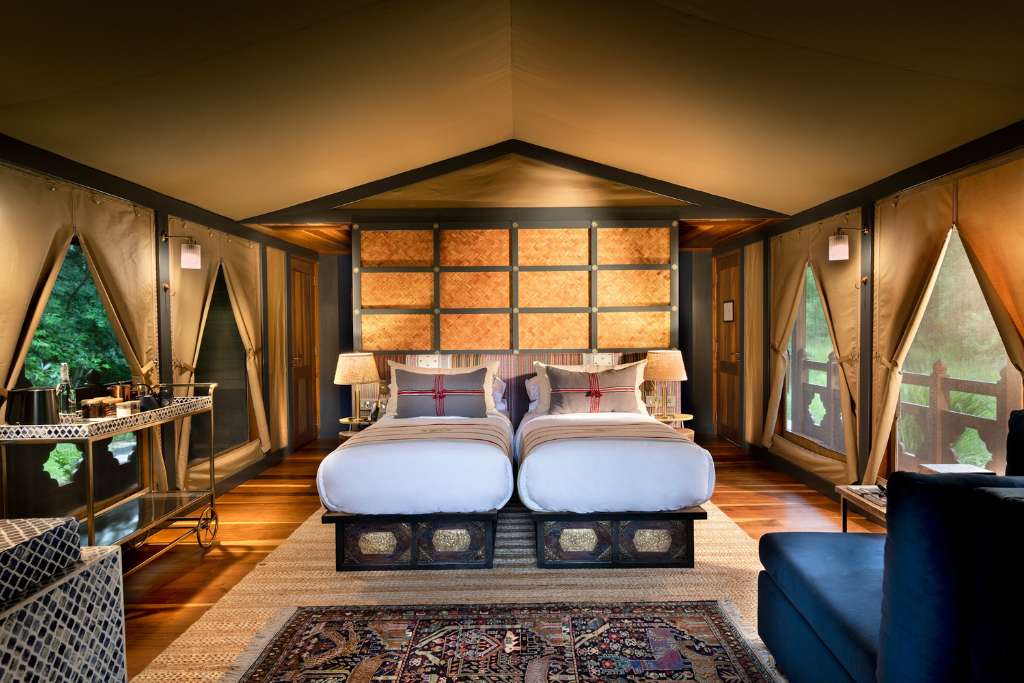
What struck me most was the philosophy underpinning every decision. Here, community is a structural pillar of how the property operates. They source rice and chillies from nearby farmers. They’ve adopted a local school, providing computers and resources. They built a dining hall and kitchen for children in the village, and nothing about it feels performative. Stewardship, as an instinct, is simply the Bhutanese way. One morning, I experienced something that still feels suspended in my memory. More than 200 monks emerged after 40 days of meditation, their faces serene, their presence so powerful it shifted the energy around us. I had the privilege of offering treats, and in that moment, I felt an overwhelming sense of reverence. Not because I was participating in a ritual, but because I was witnessing the deeply human side of devotion. The laughter, the shyness, the gratitude. Punakha felt like a region that kept whispering the same message in different ways…Freedom lives here. In the river, in the trees, in the architectural blur of indoors and out, and in the profound generosity of a community rooted to land, culture, and spirit.
Gangtey / Release
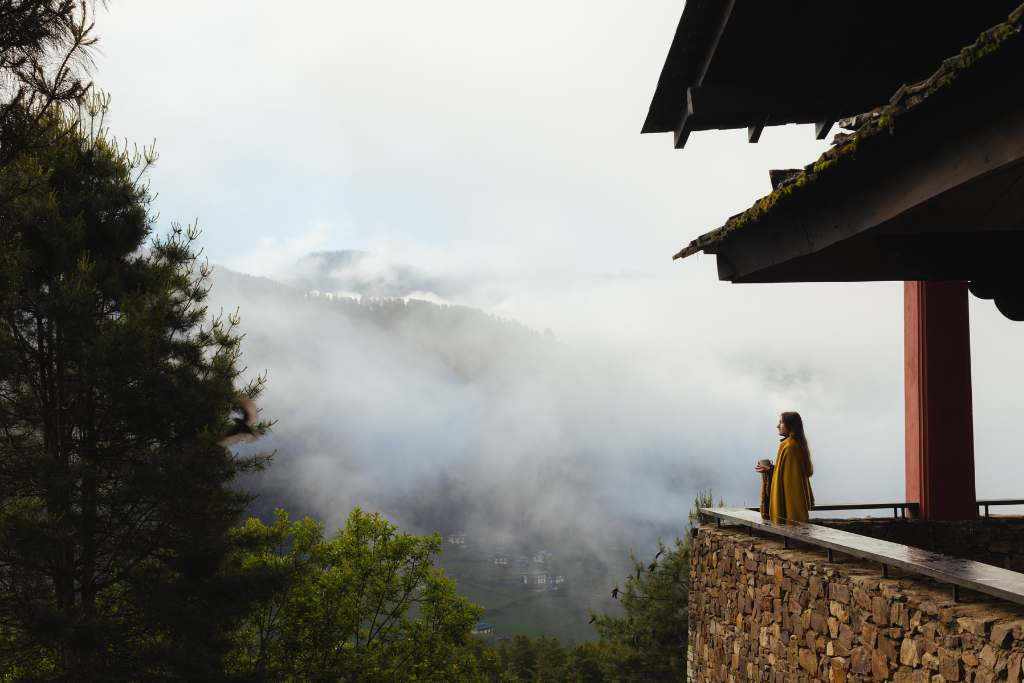
I love a good road trip (who doesn’t), and that’s precisely what I got as we wound our way into Gangtey Valley, three hours of hairpin ascents and panoramic views that felt as though we were climbing directly into the clouds. From serene moments in Thimphu to the unabashedly wild terrain of Punakha, it felt like everything was building to the crescendo of Gangtey. As we rounded the corner and approached Gangtey Lodge, there was something hauntingly familiar about the house-like architecture — as if I were returning to a home I hadn’t realized I’d been missing. The interiors are moody and cocoon-like. Fires crackle in every room, the food is comforting, deeply local and delicious, but it was the level of care from every member of the staff that will stay with me. I came down with a terrible cold, and the staff became an impromptu wellness team, brewing teas, checking in, offering remedies, and layering compassion into every interaction. The cold evaporated in record time, but the feeling of being held is still with me. The in-suite massage and hot-stone baths were not to be missed and certainly helped in my healing, thanks to the plant-based essential oils and therapeutic practices honored by the team.
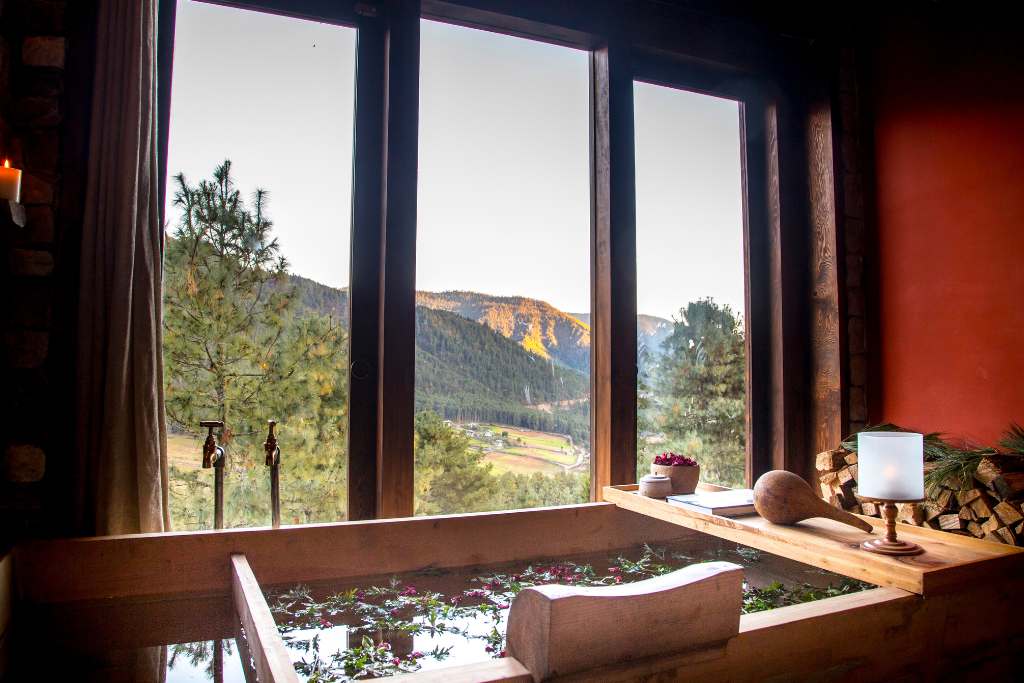
From the lodge, I visited Gangtey Monastery, where we got up close and personal with the everyday lives of monks — their sleeping corridors, their books, their comings and goings, their comradery and laughter echoing in courtyards. Buddhism often feels ethereal and untouchable in concept, but here it was human and almost ordinary in the most extraordinary of ways. As we ambled about, we were introduced to Angay (Bhutanese for grandmother), a local woman who has dedicated her life to caring for the monks. Through the Conscious Travel Foundation, she received a meaningful refurbishment to her home— — an act of giving back for her lifetime of service. Angay beamed with pride as she toured us through her home and the gratitude in that room felt like its own kind of blessing. Gangtey taught me that beauty is not always bold. Sometimes it’s measured and patient and slowly unveiled. Sometimes it meets you right where you are — tired, sick, overwhelmed — and says, Rest here. It is a place that asks nothing of you except presence, and in return, it offers clarity. A softening. A kind of internal reset. For me, Gangtey was a release — a deep exhale toward surrender.
Paro / Pause
For my final stop, we journeyed back to the beginning, where my flight landed in Paro. Upon returning, the valley felt both lulling and still, as though the mountains here carry a quieter frequency. The drive back from Gangtey unfolded in long ribbons of road flanked by thick forests, gridded rice fields, and the occasional farmstead slipping past the window, each mile pulling me closer to an ending I wasn’t ready to reach. Paro holds a kind of gravity, a softness that tugs at you the nearer you draw close. My last night was spent at Amankora, a woodland sanctuary that reveals itself inch by inch, almost shyly. The approach alone felt like an initiation by way of a cushioned carpet of pine needles and soft brush, creating a path so springy you literally bounce your way to the entrance — it was whimsical and grounding all at once.
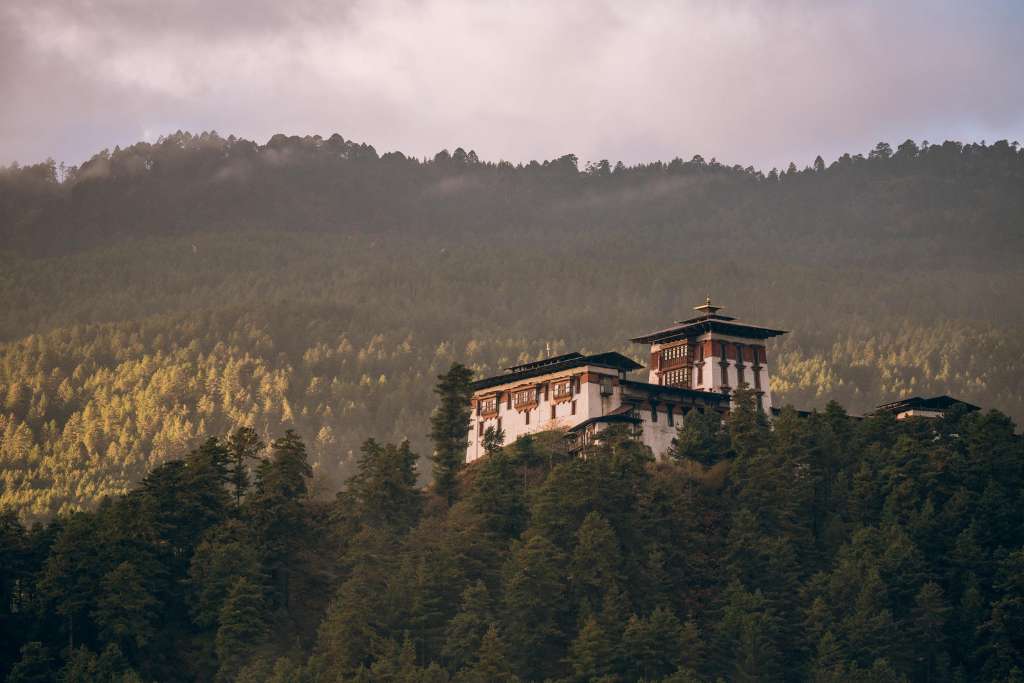
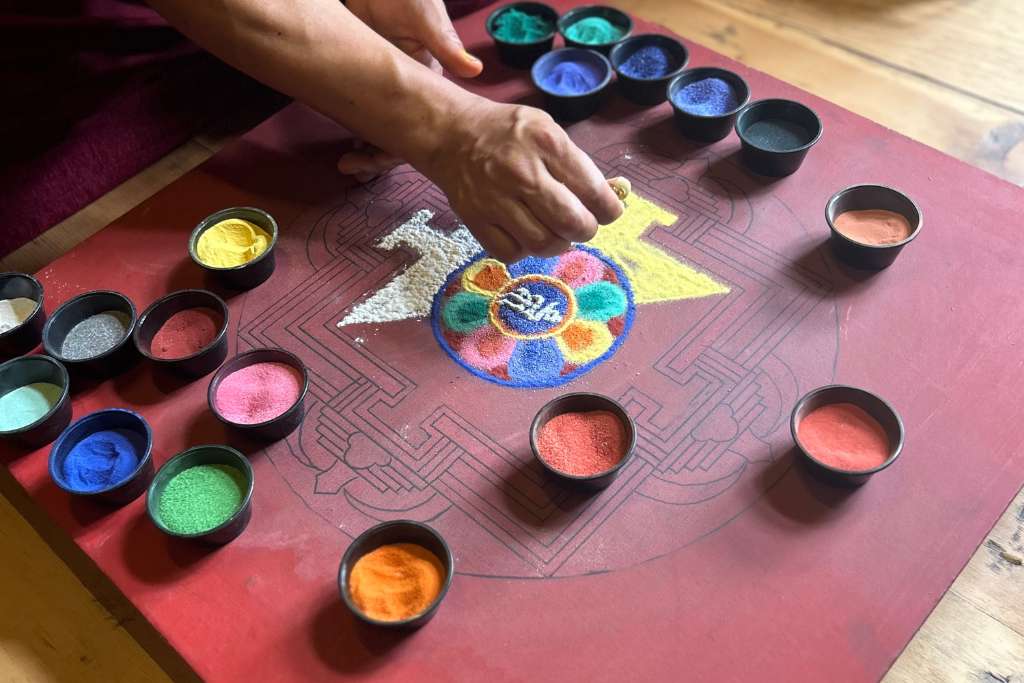
True to Aman’s distinct dialogue of understatement, the property is a study in materiality. Stone, wood, and earth-toned textiles come together in a restrained, harmonious tempo that allows the surrounding forest to remain the star. Light behaves differently here — softer, more diffused — pooling across floors and casting elongated shadows that shift as the day does. Acting as a conduit for nature’s agenda, the architecture doesn’t dominate but rather participates in a conversation between form and landscape. While on the property, a monk introduced me to Dzongkha calligraphy, the ancient language of Bhutan, and I watched as he rendered my name in sweeping, deliberate strokes that mimicked the elegance of well-timed choreography. Later, another monk led us through the creation of a sand mandala — a kaleidoscope of color arranged with painstaking care, each grain placed with reverence. It was meditative, absorbing, almost hypnotic. And once it was complete, and after admiring its beauty in all its glory, the moment I had been silently resisting arose. With a chanting prayer and a single gesture, the colorful symmetry was dispersed. Hours of devotion undone in seconds. It was a visceral understanding of the beauty of impermanence, a central teaching in Buddhism. Once it was done and dusted, the act conjured in me an unexpected lightness that I felt not just intellectually but physically — like finally relaxing your shoulders for the first time. It’s one thing to understand the principle in practice, but it’s another to watch it fall apart beneath your own fingertips and feel unexpectedly lighter for it.
Paro was a place of thresholds for me. A landing point, yes, but also a place where lessons crystallized with soft insistence. The tenderness of Katie and my guides, the generosity of the people I met, the innate rhythm of the land itself — they all seemed to converge here, offering a closing chapter that didn’t end so much as gently trail off, like colored grains of sand returning to the earth. In the succession of emotions from one region to the next, Paro was my pause — the space where meaning settled in, where reflection took root, where I recognized the journey not as a collection of moments, but as a transformation that will hopefully continue.
Trip-of-a-Lifetime Revisited
Before Bhutan, I assumed once-in-a-lifetime trips were about scale — those far-flung places that dazzled by sheer distance or difficulty. But now, I think they’re about meaning. They function less as checklists and more as quiet compasses, pointing us toward the places that have the potential to alter us, not through spectacle, but through subtle, inner shifts. Looking back, my time spent in Bhutan evolved almost like a breath cycle, with each region marking a different emotional register. Thimphu was the inhale —steadying, spacious, a gentle filling of the lungs. Punakha was the deep exhale — unrestrained and wild. Gangtey was the release — the softening of everything inside me, the letting go, the healing. And Paro became the pause — the moment where the breath settles, where clarity pools, and where meaning finally catches up.
It was never about the distance I traveled, but the distance I covered within myself. “Travel, when done right, brings people together and helps us see the world and each other a little differently,” mused Katie, a sentiment I’ve always felt connected to, but now reverberated so distinctly in my mind and heart. She also said this trip would stay with me, and weeks after returning home, I began to notice the imprint Bhutan had made, like a watermark revealing itself in better light. The impulse to create more balance, instincts to slow down and to soften, a deeper gratitude for the smallest, simplest moments, and, the desire to lead with kindness before anything else. Perhaps those tendencies existed in me before, but Bhutan gave them intention. It watered them and allowed them to flourish. The Land of the Thunder Dragon reminded me that the places most worth traveling to ask very little of you — only your presence, an open heart, and a willingness to invite change. As one Buddhist teaching says, “When the mind is open, the path reveals itself.”
Featured image courtesy, Six Senses Thimphu